
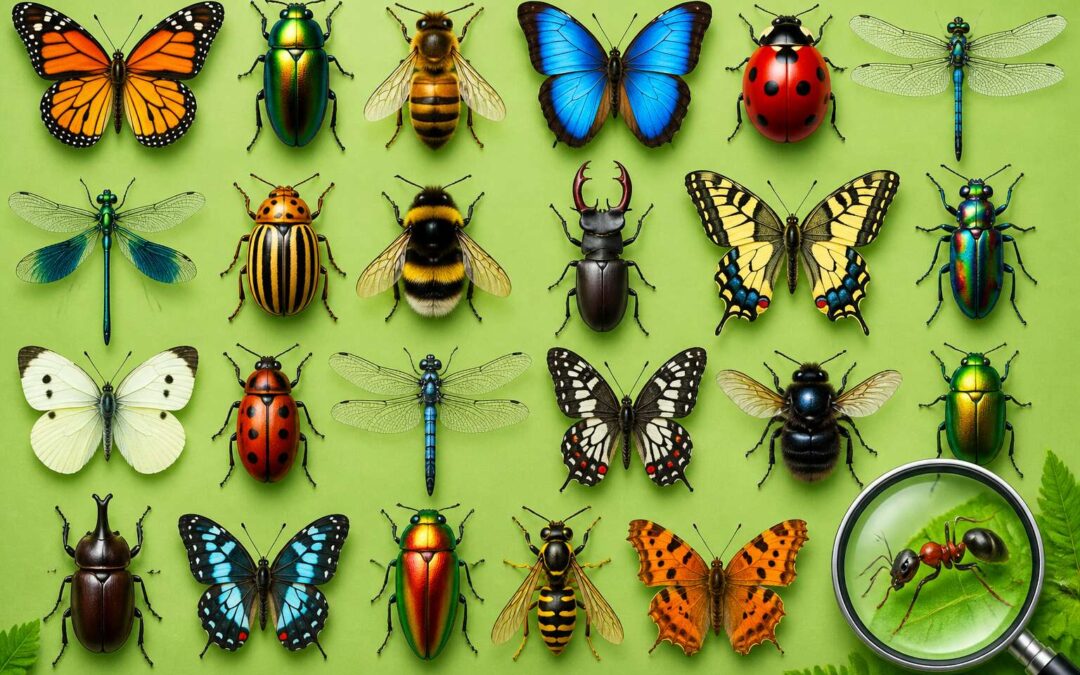
Insect Orders and Families
Beetles (Coleoptera)
Coleoptera, the order of beetles, holds extraordinary sway across southern Africa’s varied terrain. In the Cape Floristic Region, botanists have documented over 1,200 weevil species, each linked to a specific host plant. After the first rains, darkling beetles emerge across the Karoo, their black shells collecting moisture in the morning fog. Their hardened forewings, the elytra, form a protective shield over fragile flight wings beneath.
Several beetle families deserve attention in any list of the 100 insects name:
- Scarabaeidae, the dung rollers and chafers
- Carabidae, the swift ground hunters
- Tenebrionidae, the resilient darkling beetles
- Curculionidae, the snouted weevils
The African Goliath beetle, Goliathus orientalis, may weigh 47 grams, heavier than a Cape sparrow. Watching one ascend a tambotie trunk, you understand why these creatures have drawn both awe and caution for generations.
Butterflies and Moths (Lepidoptera)
Watch a hawk moth plunge its proboscis into a long-tubed fynbos flower, and you witness an ancient alliance. While beetles grind beneath our feet, butterflies and moths govern the air and the pollinators that rely on it. In the bushveld, the dancing flight of the African monarch contrasts with the minute, lichen-like patterns of fairy moths. Any serious study of 100 insects name must grant this order its due, even if their lives span only weeks.
I find the diversity within South Africa astonishing. Consider these prominent families:
- Papilionidae, the bold swallowtails of Table Mountain and the lowveld
- Pieridae, the drifting whites and yellows of grasslands
- Nymphalidae, the rapid, gliding brush-foots and charaxes
- Saturniidae, the heavy-bodied emperor moths of the savannas
Their larvae, the caterpillars, feed specific plants, while adults sip nectar. The speckled bush-grass brown rarely travels far, tethered to its patch of shade. In open fields, the bollworm moth demonstrates how delicate balance can shift into agricultural hazard. Watching them, you sense the sheer scale of their quiet presence across the country.
Bees, Wasps, and Ants (Hymenoptera)
Beneath the soil, a different kind of kingdom hums. Hymenoptera, the order of bees, wasps, and ants, operates with a social complexity that rivals our own cities. One can encounter the vast underground metropolises of harvester ants, each colony a network of tunnels and granaries. In stark contrast, the solitary mason bee constructs its nest from mud and pebbles, a quiet hermitage for its young.
These insects are architects of their environments, their influence felt in every pollinated flower and decomposed carcass. Consider the specific ways they shape the world:
- Parasitoid wasps regulate pest populations, laying eggs within living hosts.
- The Cape honey bee, a vital pollinator of fynbos, faces constant threats from invasive species.
- Ants act as primary seed dispersers for many Karoo plants, a process called myrmecochory.
Their lives are brief, but their legacy is etched into the landscape. When you compile a list of 100 insects name, you must acknowledge these colonial insects not as simple creatures, but as the silent governors of the soil and sky. They are the unseen hand that cultivates the veld.
Flies and Mosquitoes (Diptera)
Flies and mosquitoes are often dismissed as nuisances, yet they make up nearly 15% of all animal species. In South Africa, the buzz around a braai signals more than annoyance. It indicates a biological force that recycles matter and transmits disease. When considering the 100 insects name that shape our environment, Diptera deserves attention.
Midges pollinate cacao, while malaria-carrying mosquitoes haunt the Lowveld. Their mouthparts are precise. Some pierce skin, others sponge nectar. Fly larvae thrive in water, dung, and carrion, supporting entire food webs.
- The yellow fever mosquito peaks at dawn.
- Tsetse flies target large mammals.
- Robber flies hunt on the wing.
These extremes show why this order matters. A complete list of 100 insects name must include flies and mosquitoes. Without them, decomposition would stall.
Grasshoppers and Crickets (Orthoptera)
The veld erupts in a percussive symphony when the summer heat peaks. This is the domain of Orthoptera, an order where sound and survival are intertwined. In South Africa, the plaintive call of the cricket is a fixture of the long nights, a metronome for the season. These insects are not merely vocalists. They are a critical food source for everything from storks to monitor lizards, and their presence signals a healthy grassland ecosystem.
Their life cycle is one of direct transformation. Unlike the dramatic metamorphosis of butterflies, grasshoppers emerge as miniature adults, molting repeatedly as they grow. This efficiency allows them to exploit sudden bursts of vegetation after rain. Some species, like the Brown Locust, can erupt into devastating swarms that darken the Karoo sky. It is a stark reminder that these primary consumers can shift the balance of agriculture in a single season.
While many are solitary, their collective impact is undeniable. Their mandibles are designed for shearing tough grass blades, a process that returns nutrients to the soil through their droppings. To understand their variety, one only needs to listen to their differing signals.
– Katydids produce high frequency trills that are often mistaken for electronic noise.
– Mole crickets dig with spade like forelegs and call from underground chambers.
– Pyrgomorphs, or gaudy grasshoppers, display warning colors to advertise their toxicity.
New Zealand’s weta are among the heaviest insects on Earth, while the longhorn grasshoppers of the tropics are masters of camouflage. A full catalogue of 100 insects name requires this fascinating group. They embody the raw, sonorous energy of the African bush, a constant reminder that the smallest voices often carry the clearest message about the health of our land.
True Bugs (Hemiptera)
Around 80,000 species strong, the Hemiptera are the punks of the insect world. They all share a single defining feature, a straw like mouthpart called a rostrum. This is not a tool for sipping lemonade; it is a precision instrument for piercing and draining. Whether they target plant stems or the soft underbelly of a rival insect, their feeding method is a lesson in ruthless efficiency, a prime suspect in any audit of the 100 insects name.
Their life cycle skips the grub stage entirely. They emerge as nymphs, which are essentially miniature versions of the adults, lacking only wings. This is a stark contrast to the dramatic overhauls seen in butterflies or beetles. This efficiency means they can establish colonies with alarming speed, turning a single lush garden into a scene of yellowed, withered chaos in a matter of weeks.
While many are agricultural pests, the order is not without its heroes. Certain assassin bugs are the vigilantes of the garden, hunting caterpillars and other soft bodied foes. Their method is brutal, injecting a paralytic cocktail before slurping up the liquefied insides. Some of the more impressive specimens to add to your 100 insects name list include:
1. The Goliath Stink Bug, a hefty shield bug with a defensive stench that lingers.
2. The Harlequin Bug, a gaudy orange and black menace that targets veggie patches.
3. The Water Strider, which skates across ponds on the surface tension of the water.
4. The Cicada, whose deafening drone is the soundtrack of a South African summer.
The plant feeders get the most attention, but the predatory species are often the ones we should cherish. These bugs are a vital control mechanism in the ecosystem, keeping other insect populations in check. Without their silent, sap sucking and flesh piercing work, the balance of the veld would tilt into a different kind of chaos. They are a testament to the sheer diversity contained within that simple goal of compiling a roster of 100 insects name.
Insects by Habitat
Garden and Backyard Insects
Most South African gardens host dozens of insect species, each with its own habits. The praying mantis waits among the aloes with a stillness that outlasts any human patience. The humble earwig, unfairly maligned, patrols the compost heap with maternal devotion.
A proper garden census reveals a cast of regulars:
- Praying mantises (Mantodea), the ambush specialists of the flowerbed
- Stick insects (Phasmatodea), masters of botanical camouflage
- Termites, the industrious recyclers beneath the soil
- Earwigs (Dermaptera), custodians of decaying matter
Dragonflies and damselflies patrol the evening air above the pond. These species contribute to the 100 insects name that a diligent gardener might encounter over a single season. The garden runs on its own social code, complete with manners, hierarchies, and quiet rivalries, all playing out beneath the proteas and lavender.
Forest and Woodland Insects
Forest and woodland insects remain the quiet engineers of the South African bushveld, where the canopy filters light into a mosaic of green and shadow. A careful observer might find the emperor moth caterpillar stripping a wild olive branch, while beneath the leaf litter, the armoured darkling beetle trundles through its patient scavenging. These sightings add yet another layer to the growing 100 insects name census that any serious naturalist keeps.
The woodlands hold their own community, distinct from the garden visitors. Longhorn beetles emerge from dead yellowwood trunks after years of larval development. Snout beetles cling to the bark of stinkwood trees. Assassin bugs wait among the ferns for unsuspecting prey. The forest floor supports its own rituals of decay and renewal, all humming with quiet purpose.
– Forest emperor moths (Saturniidae)
– Longhorn beetles (Cerambycidae)
– Snout beetles (Curculionidae)
– Armoured darkling beetles (Tenebrionidae)
– Assassin bugs (Reduviidae)
One particular resident deserves mention. The woodland mantis, a close relative of the garden species, blends perfectly into the mottled bark of the karee tree. It moves with glacial patience, its forelegs folded in a posture of perpetual readiness. The forest offers no applause, only the occasional shaft of light breaking through the canopy. Yet every square metre hides a dozen such lives, each one contributing to the wider story of the 100 insects name that fill our landscapes.
Freshwater and Marine Insects
When we talk about the 100 insects name, we often picture land dwellers. But freshwater insects hold their own quiet drama. In the still reaches of the Vaal River, a dragonfly nymph waits for a tadpole, while a water scorpion stalks the reeds. These predators shape life beneath the surface, and they are surprisingly abundant!
Marine insects are fewer, yet just as remarkable. The sea skater is the only true ocean-going insect, skating across the swells. Mangrove mosquitoes lay their eggs in tidal puddles, surviving where few others can. Tracking these species is essential for a complete census, so here are three to remember:
- Dragonfly nymphs (Anisoptera)
- Water scorpions (Nepidae)
- Sea skaters (Halobates)
Each observation deepens our understanding of aquatic ecosystems and adds another entry to the growing 100 insects name list.
Desert and Arid Insects
In the Karoo, rainfall averages less than 150 millimetres per year. Yet desert insects have evolved strategies that work under extreme heat. The antlion’s larva digs a conical pit in loose sand, waiting for a disoriented ant to tumble in. That predator is a prime candidate for the 100 insects name list.
Consider the dune silverfish, which leaps across sand at 50 degrees Celsius. Or the sand termite, which constructs moisture-trapping mounds from cemented grains. These species exploit fog and dew as their only water sources.
- Antlion pits: precision traps that require zero maintenance
- Dune silverfish: heat-shock proteins protect their cells
- Sand termites: mounds that capture fog moisture
Tracking such adaptations adds depth to any insect census. Each desert species shows how insects adapt to scarcity.
Household and Structural Pests
Some estimates suggest a single house can host over 100 distinct insect species. The domestic environment, for all its sterile surfaces and sealed windows, is a veritable wilderness for the synanthropic dwellers among the 100 insects name list. These are not the wandering garden visitors; they are permanent residents, having traded leaves and soil for timber and carpet fluff.
The German cockroach (Blattella germanica) is the undisputed monarch of the humid kitchen corner. It requires warmth and moisture, and our skirting boards provide the perfect labyrinth. Their populations build silently, with nymphs emerging from hidden oothecae behind fridges. These pests are often joined by the furniture beetle, whose larvae spend years tunnelling through structural joists. You only notice their presence when the wood gives way under a hand’s pressure, leaving a fine dust that looks like flour.
- German cockroach: thrives in warm, humid microclimates
- Furniture beetle: a slow, destructive wood borer
- Common clothes moth: targets keratin in wool and fur
- Brown house moth: a pantry intruder seeking dried goods
The brown house moth is a quiet intruder, fluttering at the edge of vision near the ceiling. It concerns itself with stored cereals, leaving silken threads wherever it travels. For homeowners in Cape Town’s older suburbs, the humidity makes these infestations worse, creating damp spots that attract psocids, tiny booklice that feed on mould spores. These interactions mean a single structural issue often spawns multiple insect problems. The subject of household pests is a critical pillar in any comprehensive 100 insects name guide, as these species live in closest proximity to human activity.
Role of Insects in Ecosystems
Pollinators and Their Importance
Three-quarters of food crops depend on animal pollination. Yet insects contribute more than harvests. Pollinators shape plant communities, control pests, and recycle nutrients. They hold ecosystems together, from fynbos to grassland, visible only when they vanish.
While foraging, insects move genetic material between flowers. This cross-fertilisation builds resilient plant populations. Different species pollinate at varying times and conditions, forming a buffer. When one pollinator declines, others compensate.
- Boosting genetic diversity in wild flora
- Sustaining fruit and seed production
- Stabilising soil through burrowing
- Slowing disease spread
When we examine 100 insects name, the variety is striking! Moths attend night bloomers, wasps work orchard trees, and beetles carry pollen while scavenging. Each species fills a niche. Protecting these networks protects our food system.
Decomposers and Soil Health
Dead leaves and animal carcasses would pile up without decomposer insects. Termites, dung beetles, and fly larvae break down organic matter, returning nutrients to the soil. Consider a single cow pat: within weeks, dozens of beetle species transform it into rich earth. This process sustains microbial life and improves water retention.
- Fragmenting debris for microbes
- Aerating compacted ground
- Spreading essential minerals
When you catalogue 100 insects name, you will spot these decomposers in nearly every habitat. Their absence would cripple soil fertility and food production. We depend on their silent labour daily, often without noticing.
Natural Pest Controllers
The mantis is a patient executioner. It waits, forelegs folded, then strikes. Lacewings hunt aphids in the dark hours. Dragonflies patrol the air above South African dams, catching mosquitoes mid-flight. These predators keep plant life from being devoured wholesale. They remove the weak and the sickly, holding herbivore numbers in check.
When you catalogue 100 insects name, you find these hunters in every garden and field. Their precision exceeds any chemical spray. A single lacewing larva can consume hundreds of aphids before it matures. They work without pause. The landscape stays green because their hunger never sleeps.
Insects as Food for Other Animals
The web of life runs on chitin and hemolymph. When you catalogue 100 insects name from the Karoo to the Lowveld, you find they are the primary currency of energy. A single brood of Cape weavers requires thousands of caterpillars to fledge. The call of the hadeda ibis in suburban Pretoria is often a signal that earthworms and beetle larvae are being excavated from the lawn.
The transfer of biomass is relentless. Frogs, lizards, and birds all key into the vast protein reserves that insects represent. Even the yellow-billed hornbill, an emblem of the drier regions, subsists almost entirely on ground-dwelling beetles and termites. This predation does more than feed the hunters. It prunes the insect population, preventing any single species from dominating the landscape.
Within the freshwater systems, the dynamic shifts. Dragonfly nymphs are the wolves of the pond, while adult caddisflies become the prey of fish and birds. Consider the chain of consumers that rely on this output:
– Ants are a staple for pangolins and aardvarks.
– Termites feed aardwolves and batis birds.
– Locust swarms become a feast for storks and kestrels.
This constant consumption is a pressure valve. It keeps the herbivorous insect hordes from exhausting the veld. The predators are efficient, converting swarms into flesh and feathers. The ecosystem is a ledger, balanced by hunger and flight. The maintenance of this balance relies on the sheer abundance generated by insects, a turnover of life that sustains the entire vertebrate population above it.
Parasitic and Symbiotic Relationships
The highveld hides its most intricate alliances beneath the soil and bark. Parasitic and symbiotic relationships among invertebrates are precise, brutal, and often mandatory for survival. When cataloguing 100 insects name from this region, one finds that few creatures operate in true isolation. A single ichneumon wasp, for instance, can dictate the fate of an entire wood-boring larvae population.
These interactions are not mere background noise. They are the mechanisms of population control and nutrient cycling. Some relationships blur the line between predator and parasite, while others are models of mutual benefit. Certain ant species farm aphids for honeydew, protecting them from ladybirds in exchange for a steady carbohydrate supply. This management is deliberate, a form of livestock husbandry practised long before humans arrived.
The following examples illustrate the range of these biological contracts:
– Fig wasps pollinate specific fig species, dying inside the fruit after laying their eggs.
– Cordyceps fungi infect ground beetles, altering their behaviour before emerging from the host.
– Oxpeckers, though birds, rely on ticks they pick from large mammals, a cleaner and client relationship.
– Parasitic wasps lay eggs inside moth caterpillars, offering a slow and controlled demise.
Termites demonstrate the most complex symbiotic systems. Their guts host protozoa and bacteria that digest cellulose, a feat no termite can achieve alone. In return, these microbes receive a protected, nutrient-rich habitat. The mound itself becomes a fortress, engineered with tunnels that regulate temperature and humidity. Each of the 100 insects name in a complete survey would show similar dependencies. The veld may appear static, but beneath the surface, a legacy of chemical signals and biological bargains continues to shape the landscape.
Notable Insect Species
Rare and Endangered Insects
Most endangered insects vanish before they ever appear in a 100 insects name guide. The Lord Howe Island stick insect, once declared extinct, survived on a single sea stack for decades. Its rediscovery stunned the scientific community!
The St. Helena earwig was not so fortunate. Last seen in the 1960s, it fell to rats and habitat destruction. Dragonflies face quieter threats: wetland drainage erases breeding sites before surveys can even record them. South African researchers confront the same urgency as mountain streams warm and seasonal pans dry up.
- Lord Howe Island stick insect: fewer than 40 adults in the wild
- Himalayan dragonfly: found only in a few cold mountain streams
- St. Helena earwig: presumed extinct after invasive predators arrived
Invasive and Problematic Species
Invasive insects cost South Africa billions each year. The Argentine ant, an intruder in urban gardens, displaces native ants and tends aphid colonies. Fall armyworm reached Africa in 2016 and now devastates maize harvests. These species arrive as stowaways in cargo or plants, breed rapidly, and face few natural predators. A 100 insects name guide rarely includes such troublemakers because their ranges shift quickly. The most problematic species include:
- European paper wasp: aggressive nesters that sting repeatedly
- Harlequin ladybird: outcompetes native ladybirds and bites humans
- Red imported fire ant: builds mounds that damage equipment and lawns
These species damage crops, lawns, and infrastructure. Researchers track their spread and warn that prevention remains cheaper than control. I have seen invasive populations take hold within a single season.
Insects in Human Culture and History
A golden scarab amulet once rested over the mummified heart of an Egyptian pharaoh. That single artifact represents over four thousand years of human fascination with the six legged world. While we often speak of insects in terms of ecosystems and agriculture, their deeper imprint on our art, language, and belief systems is profound. The scarab beetle, for instance, became a symbol of transformation because ancient people watched it roll balls of dung across the earth, mirroring the sun’s celestial journey. For a complete 100 insects name list, one finds that many common names, like the praying mantis, are direct translations of cultural descriptions.
In South Africa, the connection is equally tangible. Consider the mopane worm, the caterpillar of the emperor moth. It is not merely a protein source across Limpopo and Mpumini; it is a seasonal economic driver and a marker of cultural identity. The timing of its harvest dictates market cycles. Ancient rock paintings in the Drakensberg depict eland and other game, but entomologists have found that insect motifs also held symbolic space. The dung beetle, in particular, features prominently in San folklore as a creature tied to the sun and creation. These historical threads show that the relationship is rarely passive.
Humanity has not always been reverent. The Biblical plagues of locusts were less a metaphor and more a chronicle of social catastrophe. In medieval Europe, the cockchafer was blamed for crop failures, and it was not until the 19th century that the beetle was formally exonerated by science. The world’s inventory of insects, from the sacred scarab to the western honey bee, carries a linguistic weight that goes beyond their biology. We name them, we measure them, and in doing so, we project our own hopes and fears.
Consider the ways insects have become silent witnesses in our record:
– The scarab seal used to stamp legal documents in ancient Egypt.
– The bee motif carved onto stone reliefs in the city of Çatalhöyük.
– The butterfly as a symbol of the soul in ancient Greek funerary art.
These examples illustrate a shared human tendency to use insects as a lens for our own existential questions. The sacred scarab of Egypt, the royal insignia of the Merovingian kings, and the humble cricket in Victorian poetry all point to a species that projects its own narrative onto the natural world. The most recent shift in perspective, though, is a scientific one. We have moved from seeing insects as metaphors to acknowledging them as the infrastructure of the biosphere. When we compile a comprehensive list of a hundred insects name, we are not just cataloguing biology; we are tracing the silent, persistent influence that has shaped our mythologies and our histories.
Insects with Unique Adaptations
Within the broader 100 insects name list, a handful of species stand apart for their extreme biological engineering. These are not anomalies or oddities. They are solutions shaped by millions of years of evolutionary pressure. The bombardier beetle, for instance, defends itself by directing a boiling chemical spray from its abdomen. The mechanism is precise. Two hydroquinones mix with hydrogen peroxide in a blast of exothermic heat. The result is a pulsing jet aimed directly at predators. Few insects match this defensive efficiency.
Predators often drive the most intricate evolutions. The orchid mantis displays a body that mimics the petals of tropical flowers. It waits on the bloom, and the camouflage does the work. Prey approaches, failing to see the lethal forelegs beneath the floral mask. This is not mimicry for display; it is functional deception. The adaptation is so refined that the mantis can lure pollinators more effectively than the flower itself.
Some adaptations involve chemical warfare, not defensive, but reproductive. The male butterfly of the Danaus genus consumes pyrrolizidine alkaloids to synthesize pheromones essential for courtship. Without these compounds, the male is effectively invisible to females. He seeks out withered plants specifically for this chemical procurement.
Specific examples of extreme survival mechanics include:
1. The pistol shrimp, which snaps its claw to collapse a bubble with a force comparable to a jet engine.
2. The Atlas moth, which uses wing patterns that cleverly resemble snake heads.
3. The antlion larva, which digs conical pits and waits at the bottom for mechanically trapped prey.
These species demonstrate that adaptation is rarely extreme in itself. It is simply the difference between thriving and vanishing. When compiling a full 100 insects name collection, one must acknowledge these biological outliers. They are the evidence that life will find a specific, often bizarre, path to survival.
Medicinal and Scientific Uses of Insects
Roughly 20% of all known species on Earth are insects, yet their pharmaceutical potential remains underused. In South African laboratories and clinics, the medicinal and scientific applications of these creatures are turning ancient remedies into measurable outcomes.
Lucilia sericata larvae, the green bottle fly maggots, are introduced to chronic wounds, where they debride necrotic tissue with surgical precision. Meanwhile, honeybee venom is being studied for its melittin compound, a peptide that shows activity against inflammatory conditions. These are not folk tales. They are reproducible trials!
- Silkworm cocoons supply fibroin for biocompatible sutures.
- Chitosan from beetle shells accelerates clotting.
- Drosophila melanogaster, the fruit fly, remains a key organism for genetic research.
When cataloguing the full 100 insects name, one discovers that the smallest bodies often provide the most significant scientific information. I find this efficiency remarkable.