
Biology and Physical Characteristics
Anatomy of a Ladybug
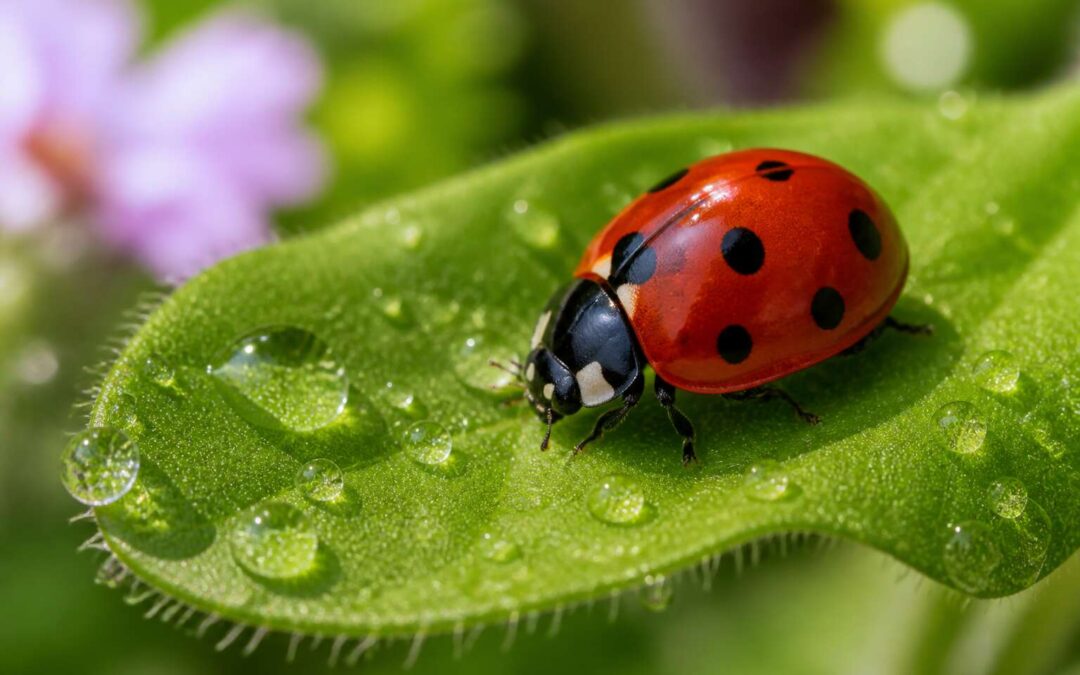
Roughly 6,000 described ladybug species roam the planet, and South Africa hosts a healthy share. Their anatomy achieves compact efficiency. The elytra, hardened forewings, shield the membranous flight wings folded beneath.
The head tucks neatly into the pronotum. Two compound eyes and clubbed antennae process visual and chemical cues. Mandibles grip and shear prey like aphids.
Key anatomical components:
- Elytra with aposematic coloration
- Nine-segmented antennae
- Tarsal claws for gripping foliage
- Tibial spur for grooming
The prothorax bears the six legs. A reflex bleeding system operates from the tibiofemoral joints, secreting distasteful hemolymph. This chemical defense is widespread among insects ladybug species in South Africa.
Color Variations and Spot Patterns
There is a somber elegance to a ladybug’s shell, the way its spots scatter like ink spilled on a crimson shroud. In South Africa, the insects ladybug wear a thousand different faces. Some are pale as bone, others black as midnight soil. The pattern of each elytron is not mere decoration; it is a warning written in pigment. I find the most unsettling variations among the smaller species, where spots fade into ghostly smudges or sharpen into jagged points. Consider the forms you might encounter:
- Red with seven black spots, the classic harbinger
- Yellow with pale, almost invisible markings
- Entirely black with two white flashes on the thorax
These color shifts depend on temperature during pupation, a cruel twist of fate. Even the same species can appear as a living ember or a dull stone, all within the same garden. The insects ladybug remain unpredictable, their spots a mutable sigil across the veld.
Sensory Organs and Vision
A ladybug’s vision is poor enough to miss a finger hovering above it. These insects ladybug survive through other senses. Their compound eyes, built from thousands of tiny lenses, detect motion and shadow, but little else. I find this efficiency striking.
The antennae matter more. They pick up pheromones, carbon dioxide, even the scent of aphids from metres away. Other organs assist:
- Maxillary palps taste plant chemistry before a bite.
- Body hairs sense wind and touch.
- Ocelli, simple eyes, gauge light intensity.
They navigate by smell and vibration, not by clear images. The world appears as chemical cues and tactile impressions.
Size and Weight Differences Across Species
Size varies wildly among the 5,000 known insects ladybug species. The largest, the giant ladybug, grows to 10 millimetres and feels heavy in the palm. The smallest, a South African native, measures just over a millimetre and could sit on a fingernail without notice. Weight follows a similar pattern. A typical seven-spot ladybug weighs around 5 milligrams. Others weigh half of that.
- Seven-spot ladybug: 5 to 8 mm, 4 to 6 mg
- Two-spot ladybug: 3 to 5 mm, 2 to 3 mg
- Minute ladybug: 1 to 2 mm, under 1 mg
A heavier body gives stronger flight muscles and a longer period without food. A lighter body enables quicker escapes from predators. Every species in the Coccinellidae family reflects these trade-offs.
Defensive Mechanisms and Chemical Secretions
A single startled ladybug can release a drop of fluid that tastes like rust and burns like pepper! This is reflex bleeding, a defensive mechanism where the insects ladybug exudes haemolymph from their leg joints. The yellow droplets contain alkaloid toxins, derived from their aphid meals.
- Ants retreat within seconds
- Lacewing larvae recoil on contact
- Birds learn to avoid the bitter taste
The potency of these chemical secretions changes with diet. A ladybug feeding on well-defended aphids becomes more toxic. Some species even leave faint chemical trails that signal danger to other individuals nearby, turning a single encounter into a colony-wide warning.
Life Cycle and Reproduction
The Egg Stage and Where Ladybugs Lay Eggs
A single female insects ladybug can deposit over a thousand tiny golden eggs in her brief lifetime, yet each one is placed with deliberate care. She seeks out the undersides of leaves, where aphids gather in their soft clusters. Here, among the green veins and faint shadows, she affixes her future in neat rows.
The chosen leaf must offer shelter from sun and predators. It must also promise a fresh supply of prey for the hungry larvae soon to emerge. Common oviposition sites include:
- rose bushes with tender new growth
- bean plants near dew-catching foliage
- citrus trees in sheltered orchards
The eggs themselves appear as small, elongated capsules, often mistaken for specks of pollen. Within three to five days, the translucent shells darken, signalling the imminent hatching of tiny, spiny larvae!
Larval Appearance and Feeding Habits
Emerging from those golden eggs comes a creature that could not look less like a ladybug. The larva is dark, elongated, and covered in spiky protuberances, with an appetite that borders on indecent. Where the adult insects ladybug ambles politely through aphid colonies, the larva tears through them with clinical efficiency.
The larval stage lasts two to four weeks, depending on temperature and prey. The larva moults four times as it outgrows each exoskeleton. This phase of the insects ladybug lifecycle delivers real pest control. Aphids dominate the diet, though scale insects and mealybugs are accepted without complaint.
Larval dining etiquette:
- A larva can consume dozens of aphids per day
- Larvae eat their moulted skins for calcium
- They will cannibalise siblings when prey runs scarce
This period of gluttony is essential. Once the larva achieves sufficient bulk, it attaches itself to a leaf and enters the pupal stage.
Pupation Process and Metamorphosis
Inside the pupa, the insects ladybug is rebuilt entirely. After weeks of feeding, the larva stops. It finds a leaf, anchors its abdomen tip with silk, and hangs upside down. Its final larval skin splits, revealing the pupa beneath.
Within the casing, bodily structures break down and reorganise. Imaginal discs direct the process, constructing the legs, wings, and spot patterns of the adult. The pupa neither moves nor feeds. Seven days is typical, but cooler weather slows the process to two weeks.
When the adult finally breaks out, it is soft and pale. Its wings must expand and stiffen before flight is possible.
- The pupal casing splits along the back
- The adult pulls itself free
- Wings expand and dry
- Colour and spots develop
The entire life cycle of the insects ladybug takes three to seven weeks. Every stage is a distinct creature with a specific purpose!
Adult Longevity and Seasonal Activities
Pity the poor male insects ladybug. He exists to find a female who has just woken from her winter stupor, then prove his genetic worth. That is it. After mating in spring, the female stores sperm for weeks before laying her yellow eggs on aphid-rich foliage.
The adult insects ladybug embodies seasonal contradictions. In warm South African summers, it is a tireless predator, consuming hundreds of aphids daily. When winter arrives, the same insect becomes a hibernating hermit:
– It finds rock crevices or loose bark
– It joins thousands of companions in dense aggregations
– It lowers its metabolism until spring warmth returns
Adult longevity ranges from several months to a full year. Overwintering adults survive longest, waking in August to feed and reproduce.
Mating Behaviors and Courtship Rituals
Consider the courtship of the insects ladybug, a quiet drama played out on a green leaf. After emerging from their winter aggregations, males do not perform elaborate dances. Instead, they rely on chemical signals, a pheromone trail that guides them to a receptive female. The male will mount her, and the pair may remain coupled for up to two hours. This extended embrace is a practical matter, ensuring that no rival male can displace him during the transfer of his genetic package.
The female is selective in her own way. She assesses the male’s size and vigor, which often correlates with his ability to find food. A successful courtship concludes with the male departing to search for another mate, as he will not contribute to parental care. The female, now carrying the life of the next generation, seeks out a location dense with prey. This is where the future begins. Consider the sequence of this reproductive imperative:
1. The male locates a female via pheromones.
2. Copulation occurs, lasting up to two hours.
3. The female stores sperm for several weeks.
4. She lays her clutch of yellow eggs on a leaf teeming with aphids.
This stored sperm allows her to fertilize her eggs gradually, ensuring a steady food supply for her offspring as they hatch. The entire process is driven by a single need, the survival of the species. It is a system both efficient and brutal, where the primary role of the adult is to continue the cycle before the season turns.
Environmental Factors Affecting Development
For the insects ladybug, environmental conditions shape every stage of life. I’ve observed that temperature is the primary driver, as cooler weather slows larval growth and extends pupation. Warm spells speed up development, though heatwaves may cause desiccation. Humidity affects egg survival, and sparse prey makes larvae compete more fiercely. These factors interact in complex ways.
Consider three key influences:
- Ground temperature at winter’s end determines when adults emerge.
- Rainfall patterns alter aphid populations, directly impacting food availability.
- Photoperiod signals reproductive readiness.
Each factor can tip the balance between a thriving generation and one that barely survives.
Habitat Preferences and Global Distribution
Common Habitats: Gardens, Meadows, and Forests
Ladybugs have conquered every continent except Antarctica, yet their global distribution is far from uniform. In South Africa, gardens host these insects ladybug populations year round, especially where aphids cluster on roses and citrus trees. Meadows offer a different rhythm, with tall grasses and wildflowers sheltering larvae as they hunt through the stems.
Forests present the most complex habitat. Here, ladybugs climb trunks and forage through leaf litter, seeking prey among moss and bark. Their preferences shift with seasons and altitude, from coastal thickets to highveld woodlands. Common habitats follow a simple pattern:
- Gardens, for stable food sources and shelter
- Meadows, for open hunting grounds
- Forest edges, for humidity and temperature control
This adaptability explains why these insects ladybug appear across such varied landscapes, from suburban Pretoria to wild Karoo scrub. Each environment shapes their movement and survival strategies.
Climate Tolerance and Overwintering Strategies
When winter arrives on the highveld, these insects ladybug vanish into crevices and bark, a quiet movement repeated worldwide. Their climate tolerance is astonishing. Some species endure Siberian frosts by replacing body fluids with glycerol, a natural antifreeze. Others in the Karoo dig deeper to escape the heat.
Global distribution hinges on this resilience. From Table Mountain’s slopes to the Okavango Delta, ladybugs follow aphid populations, not calendars. Overwintering strategies vary by region:
- Mass aggregations in rock piles, common near the Drakensberg
- Solitary hibernation inside hollow stems
- Migration to lower altitudes for milder conditions
Their adaptability humbles me! These insects ladybug respond to seasonal cues with a precision we are only beginning to measure.
Geographic Spread Across Continents
These insects ladybug occupy every vegetated continent on Earth, a distribution matched only by their prey. Antarctica remains the sole exception. Europe favours the seven-spotted species, while North American prairies run thick with convergent ladybugs. Africa alone supports hundreds of endemic species, many restricted to single mountain ranges like the Drakensberg or the Eastern Arc.
Altitude dictates presence as much as latitude. Ladybugs persist from coastal dunes to 4,000 metres in the Himalayas. In South America, the Andean slopes host species that never encounter their European cousins. What strikes me most is how sharply habitat preferences narrow with elevation:
- Lowland grasslands support generalist feeders
- Montane forests shelter cold-adapted specialists
- Island ecosystems encourage dwarf forms
Geographic isolation accelerates divergence. Ladybugs on Madagascar share no species with mainland Africa, a swift demonstration of how these insects ladybug adapt to new terrain.
Invasive Species and Their Impact on Native Populations
Some insects ladybug travel beyond their native ranges as stowaways. The harlequin ladybug, Harmonia axyridis, reached South Africa through trade routes and now competes with endemic species for aphids. I have watched them dominate suburban gardens in Stellenbosch, displacing local varieties within a few seasons.
Invasive populations disrupt food webs. They consume not only pests but also native ladybug eggs and larvae. This predation reduces biodiversity in fynbos and grassland ecosystems.
- Outcompeting local species for winter shelter
- Spreading fungal pathogens through dense colonies
The impact is measurable. Observations from Cape Town show clear declines in two native species since 2010. Conservation efforts must account for these dynamics to protect endemic insects ladybug populations.
How Urbanization Affects Ladybug Populations
Of all the insects ladybug on Earth, few are as adaptable as the ones thriving in your Johannesburg garden. I have seen them transition from the wild fynbos of the Western Cape to the brick-and-mortar canyons of Sandton with surprising ease. Their global distribution is a testament to this flexibility, as they populate every continent except Antarctica. Yet, the urban environment presents a paradox. While concrete jungles offer warm, dry crevices for winter shelter, they often lack the diverse prey base found in natural meadows.
Urbanization forces a shift in diet and behavior. The manicured lawns and exotic ornamental plants in South African suburbs support specific aphid populations, which in turn favor generalist ladybug species over specialists. This leads to a homogenization of species. Where a single block of flats stands, you might find:
– A high density of one or two adaptable species
– Reduced genetic exchange due to fragmented green spaces
– A decline in species that require specific native flora
The paving over of natural habitats creates isolated “islands” of greenery. This fragmentation restricts the movement of insects ladybug, limiting their ability to find mates and new food sources. In Cape Town, the expansion of suburban areas into the Cape Flats has visibly altered the local composition, favoring hardier, more mobile varieties over those with specific ecological needs. It is a silent, steady reshaping of the insect landscape right under our feet.
Ecological Role and Agricultural Benefits
Natural Pest Control: Aphids and Other Prey
A single ladybug larva can consume dozens of aphids in a day, making these insects ladybug populations essential allies for South African farmers. Their appetite extends to scale insects, mealybugs, and spider mites, which often damage crops.
In gardens and vineyards, I have seen how this natural pest control reduces reliance on chemical pesticides. Ladybugs are especially valuable in integrated pest management systems. Their presence indicates a balanced ecosystem.
- Aphids weaken plants by sucking sap
- Scale insects cause leaf yellowing
- Mealybugs produce honeydew that attracts mold
Encouraging these predators can lower crop losses while preserving beneficial organisms. Understanding their ecological role helps land stewards make informed decisions.
Impact on Crop Yields and Organic Farming
South African organic farmers often measure success by what they do not spray. In the Langkloof, orchards without chemicals depend on these insects ladybug populations to convert pest pressure into balance.
When ladybugs forage, they alter aphid behavior, causing colonies to scatter and reduce reproduction. This indirect effect supports crop yields in citrus and vineyards where pest thresholds are low. The result is healthier soil and more resilient harvests for growers who welcome insects ladybug as a measurable input in an organic system.
Role in Pollination (Optional but Beneficial)
While much is written about their appetite for aphids, the ecological role of the insects ladybug extends into quieter territories. Their movement between plants is not random; it is a search for prey and moisture, and this foraging often brings them into contact with blossoms. Adult ladybugs, particularly when pollen is scarce or during certain life stages, will consume nectar and pollen directly.
This feeding habit positions them as a secondary pollinator. Their bodies, covered in fine hairs, pick up pollen grains as they move across flower heads. They are not as efficient as bees, but their presence adds a layer of redundancy to the system. In South African orchards, this translates to a tangible benefit.
– Improved fruit set in crops like citrus and avocados where insect visitation is critical.
– Increased genetic diversity in wildflower populations adjacent to farmlands.
– A supplementary pollination service during cooler months when bee activity is reduced.
For the grower, this means the insects ladybug offers a dual return: pest suppression and a silent contribution to the harvest. It is a quiet efficiency that supports the bloom cycle without fanfare.
Interactions with Other Beneficial Insects
In the working landscape of a South African farm, the insects ladybug rarely works alone. Lacewings, hoverflies, and parasitic wasps share the same territory, each with a different feeding habit. Lacewings consume eggs and tiny larvae. Hoverflies target aphid colonies directly. Parasitic wasps take the invasive route, laying eggs inside their hosts. This division of labor limits competition and builds a layered defense against pest outbreaks.
Consider the typical assemblage:
- Ladybugs sweep exposed aphid clusters.
- Lacewings pick off hidden eggs and young crawlers.
- Parasitic wasps attack pests from the inside.
When one predator dips in number, the others compensate. For the grower, this translates to fewer chemical sprays and more stable yields. The insects ladybug, by simply showing up, anchors this interlocking team. It is a mutual arrangement where everyone, including the farmer, benefits from the silence of a well-run system.
Threats from Pesticides and Habitat Loss
The insects ladybug functions as a biological indicator. Their presence signals agroecosystem health. On South African farms, they convert pest biomass into living protein, reducing the need for synthetic inputs. This service translates directly into economic resilience, especially when aphid outbreaks threaten young crops. Ladybug predation stabilises the food web without disrupting other beneficial fauna.
However, indiscriminate pesticide application undermines this protection. Broad-spectrum chemicals kill ladybugs alongside their prey. Habitat loss compounds the issue, as monocultures remove the flowering borders and grassy refuges these beetles need. Consider the primary threats:
- Neonicotinoid coatings on seeds that persist in plant tissues
- Frequent tillage that destroys overwintering sites
- Removal of indigenous vegetation for field expansion
These pressures accumulate, leaving the insects ladybug with fewer safe havens. Their resilience depends on the choices made within the farm boundary.
Ladybugs in Human Culture and Science
Historical Symbolism and Folklore
Few insects carry as much cultural weight as the ladybug. In the quiet margins between superstition and science, insects ladybug have been read as omens for centuries. Their scarlet shells have inspired dread as often as adoration. In Slavic folklore, a ladybug could unlock heaven’s gates. In Scandinavia, one landing on a hand foretold a wedding before harvest. Across regions, their names reveal the split nature of this tiny beetle.
- In Germany, Marienkäfer, the little Mary beetle.
- In France, bête à bon Dieu, the good God’s beast.
- In parts of England, bishop-barnabee, a nod to clerical robes.
Yet darker tales persist. Some French peasants warned that a ladybug flying west carried a soul to purgatory. Even their scientific name, Coccinellidae, comes from the Latin for scarlet, a color of both celebration and blood. I find that fitting for insects ladybug, which have dwelled between the benign and the baleful.
Ladybugs as Pets and Educational Tools
Once the folklore fades, the practical side of insects ladybug comes into focus. Science has spent decades studying their appetite for aphids, and classrooms have turned these beetles into living demonstrations of metamorphosis. Children in South Africa often keep them in jars with damp leaves, watching larvae turn into spotted adults.
Keeping ladybugs as pets is less about companionship and more about observation. They do not need feeding schedules or walks. A small container with aphids or a drop of honey water suffices. For educators, they offer a low cost way to teach biology.
- They live for about a year in captivity.
- They require humidity and ventilation.
- They can be released into gardens after study.
This blend of science and simple curiosity keeps insects ladybug relevant beyond superstition.
Scientific Research on Ladybug Behavior
South Africans have long given the insects ladybug a place in stories, but the creature’s social habits deserve equal attention. Scientists watching these beetles have documented a surprisingly orderly society. They negotiate space, signal danger, and gather in vast overwintering clusters.
- Chemical cues alert nearby ladybugs to food or threats.
- Individuals adjust their pace when other beetles are present.
- Larger groups form when temperatures drop, a collective decision.
This body of work recasts the ladybug as a creature of strategy. The folklore, charming as it is, increasingly gives way to measured observation. In laboratories and gardens, the ladybug keeps revealing new layers of coordinated behaviour.
Conservation Efforts and Citizen Science
Ladybugs have left the storybook for the specimen jar, and now for the smartphone screen of a Cape Town gardener. Conservation work rests on observation. Citizen science projects across South Africa collect sightings of these insects ladybug, charting their movements across the region. I find a quiet gravity in this! One person records a cluster beneath a stone wall; another logs a single specimen on a fynbos stem. Each entry feeds a larger reckoning.
Participants typically record:
- Local species diversity across urban and rural plots
- Timing of overwintering aggregations
- Incursions of invasive species
The data exposes slow losses. Pesticide loads, fragmented habitats, warming nights. The ladybug endures as a cultural emblem, but its survival now depends on mundane paperwork. The affection we once reserved for its charm has shifted to vigilance.
Common Myths and Misconceptions Debunked
Many South Africans assume the spots on these insects ladybug indicate their age. That notion persists in schoolyards and garden clubs, yet entomologists have long debunked it. Spot patterns are inherited, not earned through time. Another common error holds that a ladybug’s bright red shell warns of venom. The warning is real, but the venom is not. Their bright colour signals a foul taste to predators, nothing more.
Science and culture often pull in different directions. I have heard gardeners swear by home remedies involving ladybugs, while researchers test their actual efficacy. Both perspectives matter. The myth of the harmless, all-female beetle still shapes how we treat them. Correcting that misconception is vital for conservation.
- Myth: All ladybugs are female. Fact: Males exist but are smaller.
- Myth: A ladybug with more spots is older. Fact: Spots are fixed at metamorphosis.
These corrections do not diminish the insect’s charm. They sharpen our attention to its actual needs!