
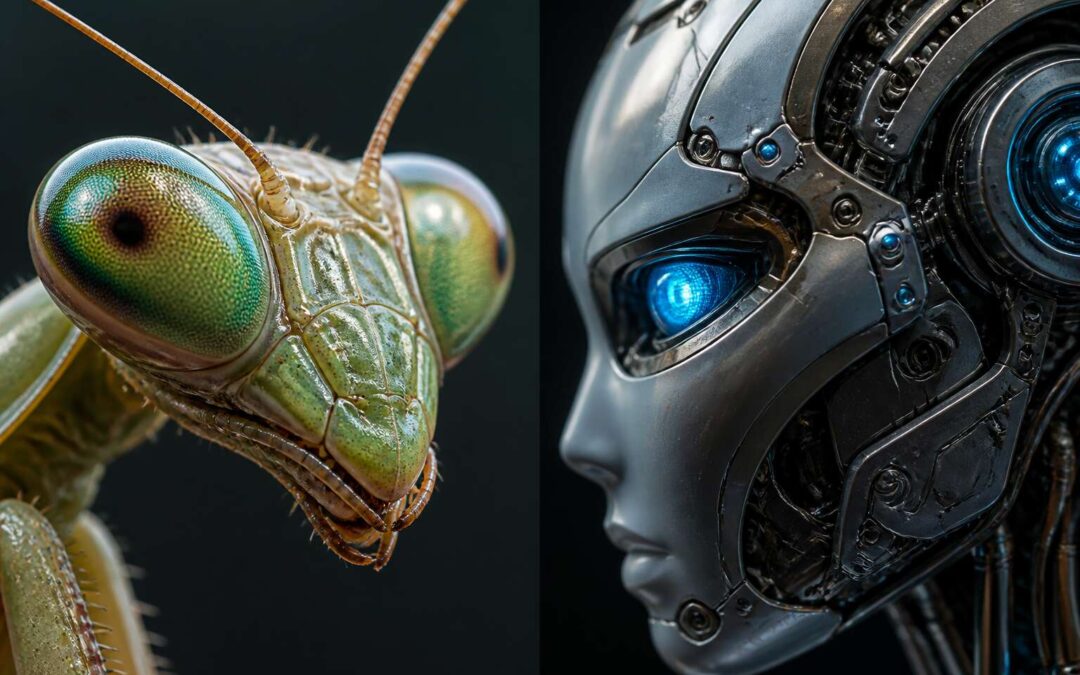
Nature’s Original Machines
Exoskeletons and Muscle Efficiency
Deep in the tangled mechanics of evolution, the insect exoskeleton stands as nature’s original machine. This chitinous shell anchors muscles to a hydraulic framework, converting microscopic contractions into leaps and carries. A flea stores energy in its cuticle like a wound spring; an ant lifts tenfold its body mass through pure leverage.
The comparison of insects vs robots hinges on this architecture. An actuator burns power per motion. An insect’s exoskeleton returns elastic energy with each stride, no external source needed. For engineers, this passive resilience is a dark puzzle.
- Locomotion without energetic waste
- Strength scaled to size
- Operation without thermal fatigue
These traits remake the debate. The exoskeleton remains an ancestral blueprint, silent and perfect, one that our machines have yet to replicate.
Compound Eyes and 360-Degree Vision
A dung beetle in the Kalahari reads polarized light through compound eyes and navigates by the Milky Way. Each eye is a dome of tiny lenses, called ommatidia, covering nearly 360 degrees. The brain processes this input with no delay. It doesn’t stitch frames; it tracks patterns.
Robot vision is a single perspective problem. Most machines use a forward-facing camera. The processor analyzes a frame, constructs a depth map, then decides. That sequence introduces lag. In the insects vs robots debate, this lag is the divider.
Compound eyes offer three advantages over a lens and sensor:
- Wide-field motion detection without panning
- Faster updates than frame-based cameras
- Low power in low light
Engineers now build event-based sensors that mimic this responsiveness. But in the insects vs robots contest, the insect brain wins on speed, because it never stops to build a picture. It reacts.
Flight Dynamics of the Insect Wing
A bee beats its wings 200 times per second. A housefly changes direction in 30 milliseconds. These numbers should not exist in the insects vs robots conversation, yet they define the gap.
The insect wing is not a rigid rotor. It twists, bends, and claps. The leading edge vortex, a swirling bubble of air that clings to the wing, produces lift at angles where a fixed aerofoil would stall. No processor calculates this. The wing handles the physics through its own elasticity.
Dragonflies push further. Their four wings beat out of phase, delivering abilities no rotorcraft can replicate:
- Hovering without a tail rotor
- Accelerating sideways without banking
- Reversing direction midair
Some flies use asynchronous flight muscles, firing faster than nerve signals can arrive. That alone should reset the debate! The wing remains the unsolved problem.
Chemical Communication Systems
Chemical communication is the oldest messaging system on Earth. A single pheromone molecule can steer a moth from hundreds of metres away. No robot sensor matches that sensitivity. In the insects vs robots comparison, this gap is decisive.
Ants lay down trail pheromones that encode direction and quality. Termites identify colony members by cuticular hydrocarbons. These signals work in darkness, through soil, and across dense vegetation, conditions where radio waves fail.
- Honeybees release alarm pheromones to coordinate defence.
- Parasitoid wasps use chemical cues to locate hidden hosts.
Roboticists can build chemical sensors. The unsolved part is interpretation, the neural process that turns a molecule into action. Insects do this with a few hundred neurons. Robots require entire data centres. That is the real measure of the insects vs robots divide.
Engineering the Artificial Insect
Miniaturization Challenges in Robotics
The real test in insects vs robots is surviving scale, not copying biology. Every gear, wire, and motor must shrink to millimeter size, and that is where our technology unravels. A fruit fly’s flight muscle produces enough lift at a fraction of a watt; our micro-actuators require ten times the energy for half the force.
Heat becomes a paradox. Smaller volume means less heat capacity, yet smaller surface area means less cooling. A robot that flies for two minutes will melt its own circuit board.
- Battery energy density remains tenfold below insect fat stores
- Precision assembly tolerances hit material limits
- Sensor wiring exceeds the weight of the entire exoskeleton
I once spent three weeks aligning a single rotor bearing. The real contest is not ideas; it is physics!
Power Sources for Micro-Automata
Nobody wins an endurance contest on a full battery. The hardest metric in the insects vs robots matchup is joules per gram per second. A hoverfly converts nectar into thrust at an efficiency our best micro fuel cells cannot match!
I have seen promising designs fail on a lab bench because the power supply outweighed the entire chassis. So where does the energy come from for a practical micro-automaton? Three avenues show real traction:
- Catalytic hydrogen peroxide microthrusters, which release energy on demand without combustion.
- Piezoelectric harvesters that scavenge stray vibration from the host structure.
- Direct methanol fuel cells with passive air-breathing cathodes.
Each approach trades complexity for endurance. The insects vs robots contest will be decided by who packs the most usable energy into the smallest chamber, not by who copies the prettiest wing.
Sensor Fusion for Autonomous Navigation
Give a robot fly a map and it will still crash into a window. The real trick is sensor fusion, merging accelerometers, gyroscopes, and optical flow sensors into one navigational picture. Biological insects perform this fusion with a brain the size of a grain of sand. Our robots need a modest microcontroller and a stubborn algorithm.
For autonomous navigation, the artificial insect must prioritize. Collision avoidance beats path planning. The typical sensor suite includes:
- Optical flow sensors for looming objects.
- Inertial measurement units for rotation and drift.
- Ultrasonic rangefinders for close obstacles.
Fuse these streams correctly and the robot can weave through a crowded workshop without a joystick.
Sensor fusion is where the insects vs robots matchup becomes a fair fight. In the broader insects vs robots contest, reliable data fusion wins the navigation trophy. Insects win on efficiency, but robots win on repeatability. A fly reacts in milliseconds. A robot with a Kalman filter reacts with calculable precision. The question is whether that precision matters when a gust of wind arrives.
Material Science for Flexible Joints
The chitinous hinge of a beetle’s leg bends a million times without a whisper. Our artificial replacements grind and wear from friction. Material science is the failure point for many robot limbs. The joint is where the insects vs robots contest turns anatomical. We bolt bearings into brass housings; the cockroach simply grows a new cuticle layer.
Consider the click mechanism of a flea. A spring loaded latch that fires faster than the muscle can contract. Replicating that snap demands shape memory alloys that shudder through their phase change at impossibly small scales. The candidates each carry a quiet flaw:
- Titanium flexures, strong but prone to fatigue.
- Carbon fiber composites, weary of repeated strain.
- Polymer tendons, quick to soften in the heat.
Insects vs robots: the machine has raw strength, but the insect has the joint that forgives, the connection that absorbs the landing, the twist, the fall.
Performance Showdown: Speed and Agility
Acceleration and Maneuverability Metrics
A fruit fly banks a turn in less than one-fiftieth of a second, pulling g-forces that would incapacitate a human pilot. Against that benchmark, the most advanced micro-drone loses its composure entirely.
Measure insects vs robots on acceleration, and the arthropods win by a margin that feels almost rude. Cockroaches reach fifty body lengths per second from a standstill. Robots require computational pre-planning for such bursts; insects treat them as casual manners. Three metrics separate the species:
- Angular velocity, measured in radians per second
- Time to reach ninety percent of peak speed
- Turning radius relative to body length
Recent agile robots adopt flexible actuators to mimic those torque-rich movements, yet nature still holds control authority. The insects vs robots contest is no longer about whether the machines can catch up, but how quickly they can learn the moves.
Energy Consumption per Meter Traveled
A honey bee travels ten kilometres on a drop of nectar. The same distance would drain a micro-robot’s battery several times over. Energy consumption per meter travelled exposes the deepest gap in the insects vs robots debate.
Insects burn fuel with biological precision. A cockroach’s muscles convert nearly all their input into forward motion. Robots lose precious watts to heat, friction, and the constant load of onboard processors.
- A fruit fly uses microjoules to traverse one meter.
- A comparable micro-drone uses joules, often a thousand times more.
That chasm forces engineers to rethink power architectures entirely. Nature’s hardware has had millions of years to optimise. We are just beginning to catch up!
Biomimicry’s Greatest Hits
Ant-Inspired Logistics Algorithms
Let’s be honest. If we had to design a traffic system for Johannesburg, we’d probably create a gridlock that would make a taxi rank look serene. Ants, however, figured out the logistics puzzle millions of years ago. They use pheromone trails to find the most efficient routes to food, constantly leaving a chemical breadcrumb trail that shifts based on traffic conditions. This is not fuzzy nature magic; it is a sophisticated algorithm that effectively solves the “traveling salesman problem” on a daily basis.
In the great debate of insects vs robots, the ants have already won on the optimization front. They don’t need a central controller or a powerful AI. They simply rely on a swarm of simple agents leaving chemical mementos. This emergent behavior is a goldmine for industries that struggle with complex routing. Disgruntled logistics managers can study this chemical communication to improve their own fleet efficiencies.
The results are incredibly practical for our local context, from mining operations to supply chain management. By applying ant colony optimization, companies can shave hours off their delivery times without upgrading their vehicles. These algorithms are especially good at adapting to dynamic obstacles, like the unpredictable ebb and flow of traffic we experience daily.
– They help telecommunications companies, like Telecom Namibia, reroute data around congestion.
– They assist courier companies in planning delivery loops across sprawling metros.
– They enable online retailers to streamline their warehouse picking paths to reduce worker fatigue.
We may have the hardware advantage in speed and strength, but ants present a formidable benchmark in the software of coordination. Watching a colony operate reveals a form of brilliance that is decentralized and resilient. The future of autonomous vehicles might not be about better cameras or more sensors, but about translating the mathematical genius of an ant’s footstep into code.
Mantis Shrimp Vision in Camera Technology
Nature’s most extraordinary visual system belongs to the mantis shrimp, an animal with sixteen types of photoreceptors compared to our three. Engineers studying this creature have developed camera sensors that capture polarized light in a single frame. This matters for the insects vs robots discussion because visual processing remains a persistent challenge for autonomous machines.
The mantis shrimp’s eye processes color and polarization simultaneously through a tripartite design. Camera manufacturers in South Africa and abroad are embedding these principles into compact imaging modules. The hardware sees through glare on wet roads and detects stress patterns in glass and plastics. We are beginning to understand what these eyes can teach us. Advances include:
- Single-shot polarization capture for industrial inspection
- Compact sensors that mimic the shrimp’s scanning motions
- Improved contrast in underwater and low-light environments
These developments suggest that the insects vs robots rivalry will continue to produce breakthroughs in optical engineering.
Cockroach Stability for Disaster Robotics
Cockroaches are not glamorous. But in a collapsed building, they outperform most machines. A cockroach can sense a disturbance in the air and right itself in under 200 milliseconds. Rescue robots face the same challenge when debris shifts under their feet.
The stability of a cockroach comes from its low center of mass and passive mechanical damping. Its legs absorb shock without needing active computation. Researchers have copied this into robotic walkers that handle uneven rubble with reflexive righting maneuvers. These machines trigger corrective steps within a fraction of a second, even without a human operator.
Key features borrowed from cockroach stability include:
– Low profile body shapes that reduce tipping risk
– Sensory hairs on the cerci that detect subtle ground contact
– Compliant leg joints that store and release energy
Engineers in South Africa are testing these designs in simulated post earthquake environments. The insects vs robots comparison gains practical weight when a six legged walker recovers faster than a wheeled drone can recalibrate its gyroscope. The hardware replicates about 70% of the biological stability range. The gap lies in actuator speed. Until motors match the reflexive speed of insect muscle, the cockroach will keep its edge. Each staggered step in a test facility teaches us something valuable about balance and recovery.
Moth Navigation Systems for Drones
What strikes me about moth navigation is its economy. A moth holds a fixed angle to the Moon and flies straight for kilometers. When it meets a porch light, it spirals toward the bulb because the angle collapses. That failure mode gave drone engineers a clue. They copied the angle holding mechanism into a new autopilot at the University of Cape Town. Instead of a lunar reference, this system reads polarized light patterns from the sky.
The insects vs robots comparison becomes a question of processing speed. A moth corrects its heading in 30 milliseconds. A drone needs roughly three times longer to parse the same input. The gap will close as sensors shrink, but the moth still wins.
Dragonfly Evasion Tactics in Defense Systems
Defense engineers study dragonflies the way fighter pilots study enemy aces. The dragonfly intercepts prey with a 97 percent success rate. It reads the optical flow of its target and predicts the interception point. A defense system that copies this uses a fixed-wing micro drone with a neuromorphic camera. The camera processes motion in parallel, not frame by frame.
Dragonflies also execute the “escape maneuver.” They flip their wings to generate thrust in any direction, including backward. This tactic, called the jinking escape, confuses predator detection algorithms. South African defense researchers have tested this maneuver in autonomous swarm formations.
The dragonfly can achieve acceleration of up to 4 Gs. It changes direction in under 50 milliseconds. Its nervous system filters false targets before the signal reaches the motor neurons.
These counters are difficult to reproduce in silico. A robotic dragonfly at a Pretoria lab uses a piezoelectric actuator for each wing. The system weighs 90 grams, which is heavier than the biological model. The insects vs robots comparison shifts when a swarm coordinates. The robotic swarm shares target data through a mesh network, a capacity no insect possesses. Each unit is slower, yet the collective response outpaces the organic equivalent. The dragonfly remains the blueprint, not the boundary.
The Future of Coexistence
Pollination Robots as Ecological Stopgaps
By 2050, a third of South African fruit crops may lack sufficient natural pollinators. This is not speculation; it is the trajectory of habitat loss across the Western Cape. Pollination robots cannot replace what vanished, but they can serve as an ecological stopgap while fynbos corridors regenerate. These mechanical visitors work the early hours in apricot orchards and macadamia groves, transferring pollen with a precision that surprises growers.
- Continuous service through full bloom cycles
- Dependable coverage for large monoculture plantings
- Real time flower health data for farmers
The insects vs robots debate usually focuses on raw capability. It misses a quieter truth: insects belong here, and robots are a compromise we agreed to. In the Karoo, a tracked pollinator hums past a wild flowerbed and does not claim victory. It records the moment, waiting for the bees to return.
Search and Rescue Missions in Collapsed Structures
The same humility applies when a building collapses in Johannesburg’s CBD. Cockroaches already navigate those voids. Their flattened bodies and erratic sprints map spaces wheeled machines cannot reach. The insects vs robots debate sharpens when lives depend on entry angles. I watched a rescue robot stall at a gap a cockroach crossed in four seconds. That moment rewired my assumptions.
Search teams now pair both approaches. Robotic sensors track carbon dioxide plumes from trapped survivors, while insect escape patterns, filmed at high speed, refine the gait algorithms for those machines. The insects teach. The robots execute. Together they shorten the window between collapse and extraction, and that matters when every minute carries weight.
Ethical Considerations of Replacing Insect Populations
In the Cape Floristic Region, fynbos depends on insect pollinators that no machine has matched. The insects vs robots debate usually centres on capability, but the deeper question is substitution. If a mechanical pollinator works, does the living one lose its claim to protection? I think the opposite happens. A working robot reveals our blind spots. We cannot engineer resilience into a machine. We can only encode what we have already observed.
Consider what replacement would cost:
- Genetic diversity in pollinator populations, which no algorithm can replicate.
- Behavioural flexibility, the way wild bees adapt to new blooms each season.
- Soil health tied to insect larvae, entirely outside robotic function.
Coexistence, not replacement, should guide investment. Robotic systems should handle the environments humans have already degraded, while natural populations receive space to recover. That division is not sentimental. It is practical.
Hidden Trade-offs in the Comparison
Repair and Maintenance Complexity
Every broken drone wing costs a fortune, yet a cricket simply grows back its leg and hops away. This contrast exposes hidden trade-offs in the comparison repair and maintenance complexity between insects vs robots. Robots require precision tools, replacement components, and skilled technicians. Insects demand only time, nutrients, and a favorable environment.
The trade-offs are not symmetrical. A robot’s modular design allows swapping a failed sensor in minutes, but spare parts add weight and inventory costs. An insect cannot swap parts, yet its self-repair is automatic, though limited. I have seen a damaged micro-drone require three hours of work, while a cockroach recovers overnight from a cracked exoskeleton.
- Robot repair: fast but resource intensive
- Insect recovery: slow but biologically free
Choosing between them means weighing these maintenance realities against mission goals.
Reproduction vs. Mass Manufacturing
A factory stamps out a thousand identical drones in a single shift. A queen termite, patient and industrious, produces a lineage over years. The trade-off is rarely stated plainly. Mass manufacturing offers immediate numbers and interchangeable parts, but every unit shares the same flaws. One design error repeats a thousand times. Insect reproduction is slow, messy, and uncontrolled, yet it generates variation. That variation is nature’s hedge against catastrophe.
Consider the logistics:
- A robot factory requires raw materials, energy, and skilled operators.
- An insect colony converts scavenged cellulose into new soldiers and workers without oversight.
Neither system is superior. The factory yields uniformity you can invoice. The colony yields resilience you cannot. The question of insects vs robots deepens here. Reproduction remains the one frontier manufacturing cannot fully colonize.
Sensory Bandwidth Limitations
Consider the sensory chasm. A robot’s LiDAR unit streams millions of data points per second, while a honeybee’s optic lobe processes a small fraction of that input. The hidden trade-off is not raw capacity but relevance. Robots handle excess data; insects select what matters.
In the insects vs robots comparison, bandwidth limitations shape the contest. A robot’s sensors feed a processor that must filter noise, and filtering consumes power. An insect’s narrow bandwidth produces selective blindness, yet that blindness enables millisecond reactions. The insects vs robots trade-off extends to field conditions too.
- Robots sample the world exhaustively and pay for each sample.
- Insects sample sparsely but prioritise survival signals.
- South African engineers face this in dusty winds that confuse optical sensors, while a dung beetle ignores the same noise.
Environmental Impact of Production
Production carries hidden costs that alter the insects vs robots comparison. A robot’s chassis requires mined metals, chemical etching, and energy intensive assembly. An insect grows from a single egg using solar powered metabolism. However, the trade off reverses across time. Robots amortise their manufacturing burden over thousands of operating hours. Insects live briefly and must be replaced constantly, which multiplies their biological production footprint.
- Robot production demands rare earth elements and produces toxic waste.
- Insect production needs only food, air, and water.
- Robot disposal creates persistent electronic scrap.
- Insect death returns nutrients to the environment.
For South African engineers, the environmental impact of production tips the scale depending on lifespan. A robust robot with decades of service may outpace a colony of insects that perishes each season. The insects vs robots debate must include this temporal dimension.
Adaptability to Climate Shifts
Climate shifts expose a stark difference in the insects vs robots comparison. An insect population adjusts through natural selection over generations. A robot cannot evolve; it requires software updates and physical modifications. When drought strikes the Karoo, a beetle species may shift its activity window or enter dormancy. A field robot loses efficiency as temperatures climb past its design envelope.
Insects carry millions of years of climate stress testing in their genetic code. Robots carry thermal limits set by their components. Consider the failure modes:
- Insects die individually, but the colony persists through behavioural adaptation.
- Robots fail collectively if the platform shares a single vulnerable sensor.
The insects vs robots debate gains urgency as South African temperatures rise. A moth’s heat tolerance shifts with each breeding cycle. A drone’s thermal ceiling is fixed at the factory. This difference dictates maintenance schedules, sensor choices, and deployment windows.