
The Science of Phototaxis
Positive Phototaxis Explained
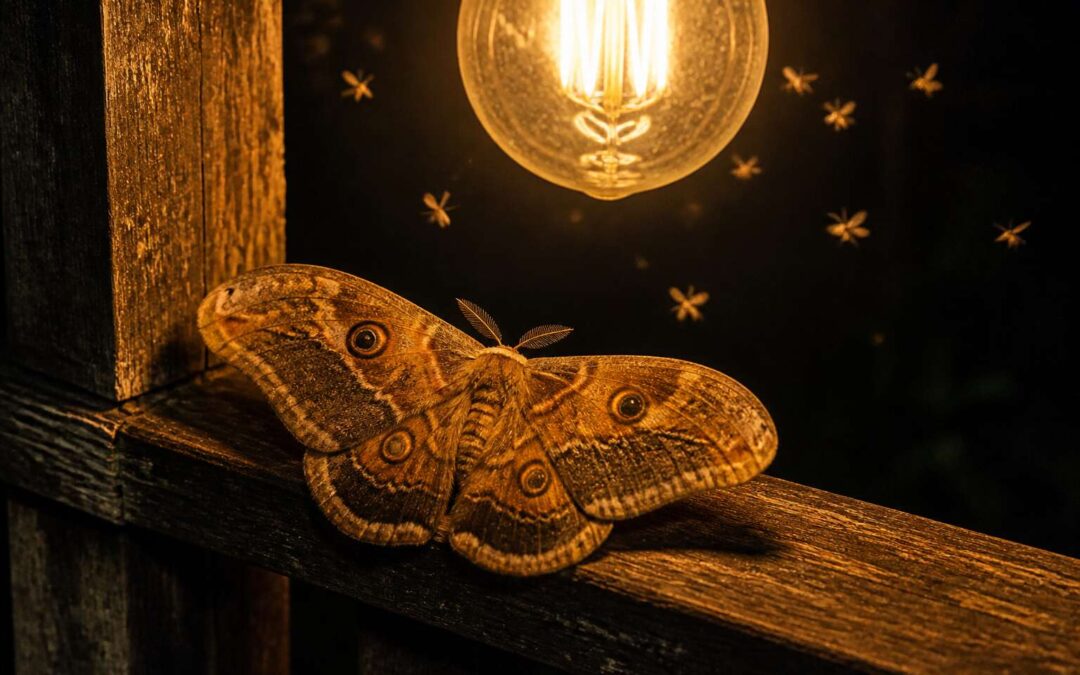
A single porch light can lure hundreds of moths in one evening. That pull is positive phototaxis, a hardwired response. Many insects navigate by a constant light source, such as the moon. When a nearby bulb replaces that steady beacon, their orientation fails. They circle endlessly instead of flying straight.
Positive phototaxis is not universal. Cockroaches, for instance, flee from brightness. But for drawn species, specialized photoreceptor cells send signals to the brain. Different wavelengths trigger different reactions, and ultraviolet light is especially potent.
Common examples include:
- Moths
- Mosquitoes
- Certain beetles
These insects evolved in a world without artificial lights. That is why insects like light today, often with fatal results.
Negative Phototaxis in Certain Insects
Flip on a kitchen light and watch the skitter. A single fluorescent strip can empty a room of cockroaches in seconds. These insects show negative phototaxis, the opposite pull. Their photoreceptor cells treat brightness as a threat, triggering escape reflexes. This response often links to moisture loss and predator exposure.
- German cockroaches
- Woodlice
- Certain ground beetles
The aversion is as precise as attraction. Different wavelengths, especially blue and white, activate these avoidance circuits. So the question of why insects like light has a counterpoint. Darkness is not empty; for many, it is shelter.
The Role of Compound Eyes in Light Detection
The science of phototaxis turns absurd when you see how insects perceive light. Their compound eyes contain thousands of ommatidia, each a separate photoreceptor. This mosaic catches light from all directions, which is why insects like light so much. A moth does not stare at a bulb; it receives brightness signals from every side. Wavelengths matter. Blue and ultraviolet attract strongly, red barely registers. The ommatidia layout drives the response. Three roles stand out:
- Each ommatidium adjusts sensitivity independently, enabling rapid responses to flicker.
- Compound eyes trade resolution for field of view, so brightness dominates.
- Neural wiring amplifies or suppresses signals based on the insect’s activity cycle.
That system explains why insects like light, even when the source misleads them completely. A candle flame mimics the moon’s glow, so the moth follows ancient programming into danger.
How Different Wavelengths Attract or Repel
A single mercury vapour lamp can outshine the moon a hundred thousand times, yet a moth still chooses the lamp. The reason lies in the spectrum. Insects have evolved to distinguish wavelengths, and each triggers a distinct neurological response.
Ultraviolet and blue wavelengths signal open space or nectar, which is why insects like light that skew cool. Warm amber tones often indicate sunset or diminishing activity. Red sits beyond most insect visual ranges entirely, which is why red LED bulbs are used to deter pests without killing them.
- UV and blue: intense attraction, linked to foraging and flight
- Yellow and green: moderate response, often ignored
- Red: invisible or mildly repulsive to most species
This explains why insects like light only when it matches their evolutionary expectations. A white bulb emits a broad spectrum, so it tricks the same neural pathways that guide insects to flowers.
Leading Theories Behind Insect Attraction to Light
The Celestial Navigation Theory
A single moth fluttering around a porch light might seem like a simple accident, but the behavior is a profound mystery that has puzzled scientists for decades. The leading explanation for why insects like light centers on their desperate need to navigate a three-dimensional world. In the darkness, the sky is a stable map, and the moon is the primary landmark.
Insects possess a remarkable ability called a dorsal light response, driving them to keep their backs toward the brightest visible point. This instinct works flawlessly under a vast, distant moon. However, when a nearby artificial light source enters the field of view, the insect’s internal compass goes haywire. The insect begins to tilt and bank to keep the light on the same part of its eye, which results in a spiraling flight path directly into the bulb.
– The theory assumes the light source is far away, which is why moths treat a streetlamp like the moon.
– It explains the erratic loops and dives seen around campfires and garden lights.
– It clarifies why insects are trapped near the light, unable to break the circuit.
Recent research in 2024 revealed that insects do not fly toward the light out of pure attraction, but rather because they are trying to orient their bodies for stable flight. The light confuses their sense of “up” and “down,” forcing them to turn their backs to the glow, even if that means crashing to the ground. This is the fatal gamble of the celestial navigation theory. It is a compelling reason for why insects like light, yet every interaction with a bulb is a tragedy for the navigator, a stark failure of an ancient instinct in a modern world.
The Escape Response and Startle Reflex
The escape response offers a far less poetic explanation for why insects like light. When a cricket or moth is startled, its first instinct is to bolt toward whatever looks like an opening. In nature, that opening is usually a patch of sky. A porch light, unfortunately, mimics that patch convincingly.
The startle reflex adds another layer of chaos. A sudden movement or vibration sends many insects into a frantic, directionless burst. They do not choose to approach the bulb. They simply flee, and the light happens to sit directly in the path of panic. This is why an evening braai attracts more than its fair share of aerial visitors.
- The escape response prioritises speed over accuracy.
- The startle reflex can trigger repeated collisions with the same light source.
Watching a moth bounce against a window is not curiosity. It is a creature trapped in a loop of alarm, unable to process that the brightest point in its world offers no exit at all.
The Ultraviolet Light Hypothesis
Ultraviolet light is invisible to humans, but insects process it as a vivid sensory map. Many species rely on UV patterns to locate flowers, identify mates, or find secure places to lay eggs. Petal surfaces often carry ultraviolet guides that lead straight to nectar. A security light emitting UV radiation triggers the same ancient feeding response, which may explain why insects like light so intensely.
The hypothesis argues that artificial light hijacks this hardwired signal. The insect is not chasing brightness. It is responding to a cue that, for millions of years, meant food or reproduction. Older street lamps with high UV output draw swarms. Warm LED bulbs, which emit little UV, attract far fewer visitors. This is why insects like light under some conditions but not others.
Some insects are especially sensitive to UV:
- Hawkmoths follow UV nectar guides.
- Dung beetles detect polarised UV from the sky.
- Aphids use UV reflectance to identify host plants.
Each species tunes into the spectrum differently, which is why certain lights act as beacons while others go completely unnoticed.
Confusing Artificial Light with Food Sources
Artificial lights can mimic the spectral signature of blooms or ripe fruit. These are high-energy foods. A moth searching for nectar may investigate a porch bulb simply because the wavelength matches a flower. It is not the brightness that deceives; it is the chemical memory in the insect’s nervous system. That is one reason why insects like light so much.
Specific insects show this confusion clearly:
– Fruit flies associate certain wavelengths with fermented produce.
– Scarab beetles mistake decorative garden lights for palm flowers.
– Some moths hover around sodium lamps because the amber glow resembles a favourite nectar plant.
These misdirected feeders waste energy and often miss real food sources. The attraction is an honest response to a false environmental signal.
Mating Swarm Behavior and Light Signals
The firefly does not wander toward your garden light for a snack. It is looking for love! Mating swarm behavior explains a large part of why insects like light when dusk settles. Certain species treat a bright spot as an assembly point. The signal is not a food cue. It is a gathering call. Unfortunately, a porch lamp looks very much like a landing zone.
- Some caddisflies rise in a dancing column over a reflective puddle.
- Mayflies approach a spotlight to join a swarm that is not there.
- Male gnats mistake a streetlamp for a group of females.
The result is a romantic failure repeated each night. The light offers no response. The insect waits, jittering above the bulb, while the real swarm gathers elsewhere. The lamp is a silent partner that never commits.
Insect Species Most Commonly Drawn to Light
Moths and Their Lunar Compass Confusion
Moths dominate the list of insects that perish at the porchlight. The death’s-head hawkmoth, the large yellow underwing, and the garden tiger moth are the most notorious. Each species evolved to navigate by the moon’s fixed glow, holding it at a constant angle. Artificial bulbs imitate that beacon, yet their close range and multidirectional light break the system. The moth’s path tightens until it circles the filament in a doomed orbit. Understanding this is central to why insects like light, though it remains a misdirection of ancient instincts.
Flies and the Buzz Around Bulbs
A single mercury vapour lamp can attract over 150 insects per hour in South African summers, and flies make up a surprising share. Their attraction is not about hunger. It is a mechanical response to specific wavelengths that mimic the sky’s ultraviolet glow.
House flies, blow flies, and non-biting midges all share a strong phototactic drive. The compound eye of a fly contains thousands of ommatidia, each sensitive to artificial light. This creates an irresistible pull, especially at dusk!
Common species at your veranda light include:
- House fly (Musca domestica)
- Lesser house fly (Fannia canicularis)
- Cluster fly (Pollenia rudis)
- Non-biting midges (Chironomidae)
These flies are not circling out of confusion, as moths do. They follow a signal tied to navigation and mate finding. That is part of why insects like light. But the buzz around bulbs is a short-lived dance. Many die from exhaustion or heat within hours.
Beetles and the Attraction of Heat and Light
Beetles arrive at artificial lights for a reason that has nothing to do with celestial confusion. Many species, including the longhorn beetle and the chafer beetle, detect infrared radiation. Incandescent bulbs emit heat that resembles warm soil or sunlit rock. On a cold Highveld night, that warmth is a survival signal.
I notice these visitors often at dusk. Common beetle visitors to South African verandas include:
- Click beetles (Elateridae)
- Darkling beetles (Tenebrionidae)
- Fruit chafer beetles (Cetoniinae)
These species respond strongly to low-pressure sodium lights, which produce both visible glow and noticeable heat.
The behaviour clarifies one angle of why insects like light. It is not always the glow itself. The warmth guides them toward shelter and a warm microhabitat.
The Impact of Light Pollution on Insect Behavior
Disruption of Circadian Rhythms
Light pollution alters the internal clocks of insects, and this disruption carries serious consequences. When artificial illumination extends the perceived day, feeding schedules and resting periods collapse into chaos. Disrupted circadian rhythms manifest in various ways:
- shifts in foraging times
- irregular mating periods
- reduced immune function
These changes affect hormone release and growth rates. Some insects become active at wrong moments, missing essential resources. Others fail to hide before predators appear. This helps explain why insects like light, but the true cost is a series of behavioral errors that reduces survival odds. The artificial glow tricks their biological systems into responding as if the sun is still up. Over time, local populations can decline because their life cycles no longer align with their environment.
Altered Predator-Prey Dynamics
When a streetlamp flicks on in Pretoria, it does more than illuminate the pavement. It rearranges the local food web. Moths and beetles abandon their usual hiding spots to orbit the glow, and that exposes them to geckos, spiders, and opportunistic birds.
The predators adapt quickly. Some learn to wait near bulbs and pick off dazed insects by the dozen. Others, such as certain owl species, lose their competitive edge because their prey never leaves the light. The result is a feeding frenzy in one spot and silence in another:
- ambush predators thrive on disoriented insects
- true nocturnal hunters find fewer targets in the dark
This imbalance is one reason why insects like light, yet it is also why light pollution quietly erodes biodiversity.
Effects on Pollination and Ecosystem Health
One streetlamp in Pretoria can redirect hundreds of moths from nearby flowers. I have watched it happen! This matters because those moths are often the only pollinators active after dark. When they cluster around bulbs instead, night-blooming plants in South Africa’s savannas go unpollinated.
Understanding why insects like light helps explain the scale of this loss. The insects are not lazy. They are following an ancient response that now works against them. The measurable effects include:
- Visits to night-blooming flowers drop sharply near lit areas
- Seed production falls, which weakens plant populations
- Fewer fruits reach birds and small mammals that rely on them
Ecosystem health depends on these quiet interactions. Light pollution removes them in plain sight. The glow that draws moths is the same glow that condemns a flower to sterility.
How Artificial Light Affects Nocturnal Migration
Every year, billions of insects embark on nocturnal migrations to find new habitats. Artificial light scrambles those journeys. A single sports stadium can act as a giant beacon, pulling migrating insects into a holding pattern until dawn. They burn through fat reserves that were meant for breeding.
Why insects like light is not a curiosity. It is a survival instinct that misfires against modern infrastructure. Migration routes that took generations to refine now curve around streetlights and security beams.
- Insects lose orientation when their internal compass ignores the moon
- They crash into windows and poles in vast numbers
- Some abandon migration entirely to circle a bulb
The impact of light pollution on insect behavior shows up in population counts. Nocturnal migration studies record fewer insects reaching their destinations in brightly lit regions. I have watched this unfold in my own backyard.
The Role of Light Intensity and Duration
Light intensity and duration change how insects respond. A low wattage bulb may only confuse insects within a metre. A high intensity floodlight can override the celestial compass of insects kilometres away. Duration compounds the problem. A light that switches on for ten minutes causes a brief distraction. The same light burning all night becomes an ecological trap.
Why insects like light is not a fixed rule. It is a sliding scale. The brighter the source and the longer it persists, the stronger the pull. In South Africa, farm security lights and urban billboards create chronic disruption. Some insects circle until their wing muscles give out. Others remain trapped near the source, unable to feed or mate.
The pattern repeats:
- Dim garden lights attract insects only from a few metres away
- Bright signs affect insects across entire streets
- Lights that run all night cause the heaviest population losses
Mitigation Strategies for Reducing Light Pollution
South Africa’s expanding towns and cities alter the night for every living thing. Every unshielded security light and illuminated billboard disrupts the nocturnal movements of countless insect species. The question of why insects like light matters less than what happens when they cannot break free from its pull.
I have seen the difference a simple change makes. Motion sensors keep properties safe without flooding gardens with constant light. Warm amber bulbs replace the blue-white emissions that confuse nocturnal navigators. Directional fittings aim light where needed, not into the sky.
- Switch to motion-activated lighting
- Use warm spectrum bulbs
- Install fully shielded fixtures
Those adjustments lower the risk. The behaviour behind that attraction remains unchanged. Our lighting choices determine whether insects survive the night or disappear from our gardens entirely.
Practical Applications and Everyday Implications
Designing Insect-Repellent Outdoor Lighting
Understanding why insects like light is not merely academic. For anyone who values a quiet evening on a Joburg veranda, it can be the difference between calm and chaos. Outdoor lighting design works around this natural pull rather than fighting it.
Consider a few practical adjustments:
- Mount fixtures low to reduce overhead glow.
- Use separate switches for entry paths and living areas.
- Choose lamp housings with non-reflective interior coatings.
The objective is to keep illumination where it belongs. A well-designed system channelises that pull away from the spaces you inhabit.
Using Light Traps for Safe Pest Control
Understanding why insects like light gives us a working tool for pest control. Light traps use this attraction to pull mosquitoes and flies away from living spaces. I have seen these units cut insect numbers around Highveld homesteads without pesticide. The traps emit UV light, drawing insects into a chamber where a fan or adhesive board retains them.
Placement and timing determine success. A trap operating at dusk catches the heaviest swarms, while one left running all night removes insects that would enter through open doors.
- UV wavelengths around 360 nanometres work best for moths and flies.
- Sticky board models need less maintenance than fan based units.
- Several small traps beat one large unit in garden settings.
For daily life, the benefit is quiet and clean. No chemical smell drifts across the veranda, only a low hum from the fan. That is a small price for a peaceful evening on the Joburg veranda!
Choosing the Right Bulb for Your Home
Every evening brings a familiar flurry of wings against the veranda window. The answer to that commotion is why insects like light, and the bulb you choose shapes the outcome. A warm amber LED draws fewer moths than a cool daylight floodlight. The short blue wavelengths in that cool light resemble the sky’s glow, so insects read it as an open path.
- Warm LED bulbs produce minimal UV and keep the fly population low.
- Cool white tubes attract mosquitoes and moths during evening hours.
- Sodium vapour lamps emit a narrow yellow band that most insects ignore.
Incandescent bulbs add another layer because they radiate heat. Beetles sense that warmth and steer toward the filament even when the light is dim. The choice of bulb therefore determines which insects visit your doorway and which stay away. That is the practical side of why insects like light.
Future Research Directions in Insect Phototaxis
Practical Applications and Everyday Implications
South African municipalities testing narrow-band street lamps are gathering data on insect mortality at a granular level. Researchers are mapping photoreceptor genes to predict which species will respond to specific wavelengths. The practical implications extend to food security, particularly for crops that depend on nocturnal pollinators. The persistent question of why insects like light now drives design decisions, not abstract curiosity.
Future Research Directions in Insect Phototaxis
Future work will focus on adaptive lighting systems that adjust in real time. Priorities include:
- Field trials in the Karoo to measure ecological recovery after switching to amber LEDs
- Genetic sequencing of nocturnal pollinators to identify wavelength receptors
- Feedback-controlled lamps that dim when insect activity peaks
The key is specificity, not elimination. Coexistence depends on understanding the underlying biology.