
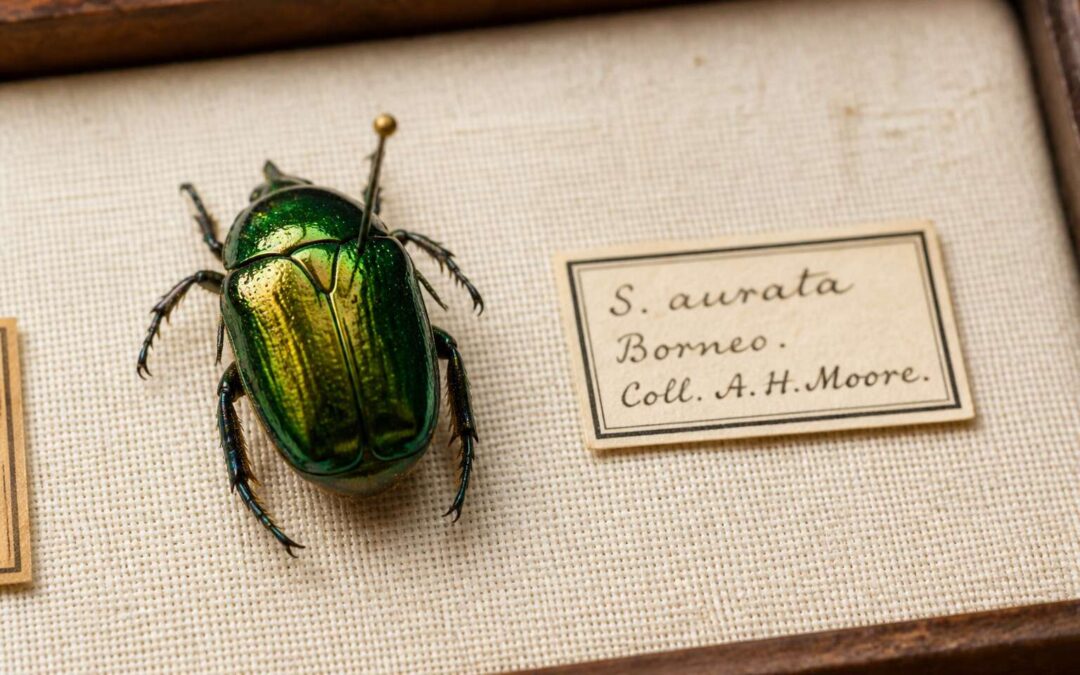
Essential Components of Entomological Data Labels
Specimen Identification Details
One missing species epithet can invalidate a lifetime of research. An insects label must carry precise specimen identification details. The species epithet, the sex, and the taxonomist’s determination convert a pinned specimen into a verified record. For South African collectors, this information connects a field find to a scientific asset. Without these core components, even a rare specimen loses its research value.
Essential components include:
- the full taxonomic hierarchy, from order to species
- the sex and life stage, where applicable
- the determiner’s name and date of identification
These elements allow researchers to trust the data. A well curated insects label saves hours of museum work and reduces the risk of misidentification. I once saw a fine moth specimen rendered useless because the sex was never noted! The collector’s code and accession number link the specimen to a permanent catalogue. Every detail on the label adds to the specimen’s continuing usefulness.
Collection Locality Data
Strip away the exact GPS coordinates and your specimen becomes a floating ghost. The humble insects label carries the weight of geography, pinning a creature to a specific patch of Fynbos or a moist valley in Limpopo. For South African researchers, this locality data is the key to unlocking migration patterns and climate responses.
Without these details, you lose the story of the habitat. Consider the essential items to record:
- Province and nearest landmark
- Precise GPS coordinates or grid reference
- Altitude and micro-habitat notes
I always record the date and collector’s name on that label too. That transforms a simple pin into a historical document. A hundred years from now, scientists can use that information to measure changes in species distribution across our varied landscapes. It’s the silent data that makes a collection truly valuable!
South Africa spans thirteen biomes, so a specimen from the Succulent Karoo tells a completely different story than one from the Savanna. The difference lies entirely within the locality field on your insects label.
Date and Collector Information
Without a date, a specimen exists outside history. The collector’s name adds a human witness to the pin. On an insects label, these two fields sustain the collection’s credibility. South African research depends on this precision. The day of capture reveals seasonal states; the name establishes ownership and accountability. Record these elements:
- Exact collection date
- Collector’s full name
- Field number or accession code
Future researchers will rely on this information to measure environmental shifts. A label with these details provides a verifiable past. A label without them offers nothing beyond the body itself.
Unique Identifier Codes
Every insects label hides a quiet cipher. The unique identifier code transforms a physical pin into a searchable datum. These alphanumeric strings, often printed as barcodes, act as the specimen’s permanent address in a museum’s digital catalogue. They are the handshake between the object and its metadata.
A robust code should reference the collection’s database without ambiguity. Some institutions embed the year of accession. Others include geographic subregion abbreviations. The KwaZulu-Natal Museum, for instance, uses a three part structure:
1. Institution prefix
2. Accession year
3. Sequential entry number
The collector’s field number, when present, records a parallel system. These codes, written by the researcher at the moment of capture, preserve a direct link to their original field notebook. Without a unique identifier, an insects label becomes an orphaned object. The specimen remains, but its digital voice vanishes.
Classification of Label Types for Biological Specimens
Pinned Specimen Labels
In the hush of a curated drawer, a pinned specimen endures, its fragile body impaled for eternity. Its insects label is a small paper rectangle that holds the essential data. Classification of label types for biological specimens begins with pinned specimen labels, the cards that share the pin with the insect. These primary labels are printed on acid-free stock and record the facts of provenance.
Secondary labels, such as type or determination slips, are pinned separately to avoid obscuring the specimen. A third tier, auxiliary labels, records storage notes or loan histories. The material matters. Heavy card resists humidity, while thin paper tears under constant handling. For any insects label, durable paper prevents the slow loss of data.
- Primary pinned labels, attached directly to the pin.
- Secondary determination labels, naming the species.
- Auxiliary labels, tracking curation events.
Each tier preserves a distinct layer of the specimen’s history, a silent record that outlasts the pinned body itself.
Vial and Microscope Slide Labels
Submerged in ethanol, a vial label fights a slow dissolution. I have seen standard ink bleed into oblivion within a year. On microscope slides, xylene and mounting media threaten every mark. These solvents erase common pens!
The insects label for fluid collections often lives as a small parchment inside the jar. Pencil works best, as graphite survives alcohols. For slides, frosted glass accepts a diamond-etched code.
- Parchment inserts for jars
- Diamond etching for slides
- Always test ink resistance
Each vessel demands a distinct classification. A label type that fails in one medium may thrive in another.
Container and Storage Labels
Most insect collections die in storage, not in the field. A specimen can survive a century on a pin, but a poorly marked drawer sends it straight to taxonomy limbo.
Container and storage labels are the workhorses of the collection. They sit on the outside of boxes, drawers, and cabinets. They classify where things live, not what they are. The insects label on a storage unit should differ from the label on the specimen itself.
Classification here is about size and durability:
- Box labels for standard entomological drawers.
- Cabinet labels for large unit trays.
- Barcode labels for digital tracking systems.
Each type has its own enemy. Humidity fades cheap stickers. Sunlight turns them brittle. A robust insects label for storage should be printed on acid free paper or laminated. The material matters more than the font.
Digital Label Records
Physical labels have limits. A paper label can tear, fade, or lose its ink to humidity. That is why modern collections pair each insects label with a digital record. The digital file holds the same data, but it survives the failures of paper.
Digital label records do more than back up information. They connect specimens to images, genetic sequences, and field notes. A researcher in Cape Town can query a database in Pretoria and pull up a specimen collected decades ago!
Classification of label types for biological specimens now includes a digital tier. The main categories are:
- Labels that travel with the specimen
- Labels that mark its location in storage
- Digital records that outlive both
That identifier is the bridge. It ties the physical label to its digital twin. The insects label remains the anchor, but the digital record extends its reach to any screen on earth.
Specialized Tags for Genetic Samples
Most genetic samples are stored at minus 80 degrees Celsius. A standard paper insects label disintegrates in those conditions. That is why specialized tags for genetic samples exist. They are printed on synthetic substrates with chemical-resistant inks. They survive ethanol, liquid nitrogen, and even repeated handling!
- Etched metal tags for ultra-cold freezers
- Laminated plastic labels for cryovials
- Barcode bands that wrap around tube necks
These tags often carry a minimal data set. The species name, the unique identifier, and the gene marker. The insects label on the pinned specimen remains in the drawer, but this small tag speaks for the extracted DNA. It is the only link between a physical bug and a sequence on a server thousands of kilometres away.
Design and Print Considerations for Durable Labels
Paper and Material Selection
A single illegible insects label can erase years of ecological data in the KwaZulu-Natal mistbelt forests. Sunlight, humidity, and ethanol vapours attack standard paper quickly. For permanent specimens, select polyester or polypropylene substrates. These synthetic films resist tearing, water, and chemical solvents.
Printing method matters as much as paper. Thermal transfer printing with resin ribbon creates a crisp mark that survives freezer storage. Pigment based toner offers better fade resistance than dye based toner. Field testing of small samples before batch commitment is standard practice!
- 0.05 mm thick polyester suits vial labels.
- Matte finishes avoid glare under microscope light.
- Adhesive bonds must suit glass or polypropylene tubes.
The adhesive layer requires equal scrutiny. I prefer acrylic adhesives for freezer work. Acrylic adhesives handle cold better than rubber based formulas. When labels face ethanol, a protective laminate becomes necessary. These choices ensure the insects label remains readable for a century.
Ink Permanence and Legibility
Every faded inscription is a tragedy, an erasure of the meticulous effort that captured a single moment in ecological time. Legibility begins with design, not technology. High contrast between ink and substrate is nonnegotiable, but so is the restraint to avoid decorative fonts that sacrifice clarity for style.
Ink permanence demands a ruthless honesty about environmental exposure. Thermal transfer with resin ribbon resists ethanol and freezer burn, while pigment based toners outperform their dye counterparts under harsh light. When an insects label faces decades of handling, consider these parameters:
- Minimum 6 point font for vial labels
- Bold sans serif typefaces for stroke integrity
- Matte surfaces to prevent ink smearing
The test comes when you hold that label under microscope lamp, forcing your eyes to confirm what your memory promises. That clarity is not a luxury, it is a commitment to the future researcher who will rely on your honesty!
Size and Typography Standards
Designing an insects label that survives decades of cabinet storage starts with geometry, not aesthetics. A label measuring 12 by 6 millimetres can hold surprising amounts of data when the typography is disciplined. Sans serif faces at 6 point or larger maintain stroke integrity through repeated freeze and thaw cycles.
I prefer a two tier layout for pinned specimens:
- Top line: taxon and unique identifier
- Middle line: locality and date
- Bottom line: collector and determination
This separation keeps the eye from hunting through crowded text. For vial labels, rotate the text along the long axis so the researcher can read without turning the container. Some printers render fine lines inconsistently. A careful proof remains the only safeguard against a wasted run of an insects label.
Layout and Information Hierarchy
The damp persistence of a South African summer tests every label in the cabinet. A poorly printed insects label looks unprofessional, and worse, moisture and light will erase it within seasons.
Design follows material. Dark ink on a pale substrate gives contrast without heavy ink deposits that crack when flexed. Layout demands hierarchy. Place the taxon and identifier where the eye lands first, then locality, date, and collector in descending prominence. Leave breathing space around blocks; crowded text loses legibility under glare.
Print considerations extend further than the machine itself.
- One freeze thaw cycle before the full run reveals whether the laminate separates.
- Ink adhesion varies across local paper stocks and requires checking on the actual batch.
- Freshly printed sheets smear if cut within hours of leaving the printer.
These steps cost minutes yet spare the collection from anonymous remnants. An insects label dies or survives before it meets the pin.
Handling and Storage of Labels
A proof run is not a formality. It is the only chance to catch a brittle ink film before it shatters across a hundred pinned specimens. The freeze thaw cycle test for laminate separation should happen on a offcut, not on your finished batch. South African paper stock behaves differently depending on the humid season, so test the exact ream you intend to use. Those fifteen minutes save the collection from anonymous remnants.
When handling the printed sheets, give the ink time to cure. Cutting within hours of leaving the printer drags pigment across the surface. Stack the sheets loosely and allow airflow between them. Once you cut the labels, the conditions of storage determine their longevity.
The immediate environment for unused insects label stock demands attention:
1. Store in a dark, sealed container to block UV degradation.
2. Keep relative humidity below 45 percent to prevent fungal spotting.
3. Lay sheets flat to avoid curling at the edges.
4. Separate stacks with acid free tissue to stop ink transfer.
A label that survives the pin but fails in the drawer is a silent loss. The collection depends on the quiet work of storage, not just the noise of the printing press.
Regulatory and Compliance Labeling for Insect-Based Consumer Products
Pesticide and Repellent Labeling Requirements
The regulatory landscape for insect-based consumer products is unforgiving. A single oversight on an insects label can trigger recalls or fines. In South Africa, the Agricultural Remedies Act governs pesticide and repellent labeling. Your label must clearly state active ingredients, concentration, and hazard symbols. The registration number is non-negotiable. Additionally, first aid statements and emergency contact details are mandatory. One surprising statistic: nearly 30% of product audits fail due to incomplete label data. Consider these core requirements for compliance:
- Exact chemical composition with percentage by mass
- Signal words like “Caution” or “Danger” based on toxicity
- Directions for use specific to target insects
Remember, the label is your legal defense. A poorly crafted insects label invites liability. Always verify current regulations before printing, as amendments occur frequently.
Allergen and Ingredient Declarations
In South Africa, a consumer insect product without explicit allergen warnings is a hidden hazard. Research indicates that a significant share of people with shellfish allergies may also react to insect proteins. That reality makes the insects label a legal shield and a safety tool.
- Crustacean cross-reactivity warning
- Complete protein source declaration
- Batch traceability code for allergen control
Ingredient declarations must list every additive, preservative, and processing aid. Under the Foodstuffs Act, omission invites fines and erodes trust. Regulatory bodies expect detailed allergen statements directly on the product label. Each production lot deserves its own accuracy check. Consumers depend on those words to stay safe.
Contact and Hazard Warning Statements
In South Africa, the regulatory framework treats an insects label as a documentary contract between producer and consumer. Contact information, including a physical address and a working phone number, must be printed directly on the package. No hidden web forms or vague email addresses! The compliance officer needs to find a human within minutes.
Hazard warnings cover risks that are not allergen related.
- Choking hazard for children under three years
- Contains small parts that may cause intestinal blockage
- Must be stored below 5°C after opening
Each statement must be specific and actionable. The National Regulator expects the wording to match the actual product, not a generic template.
A recent market survey found that 62% of South African consumers check the contact details before buying a novel food. That statistic explains why the insects label must be treated as a compliance tool, not a marketing afterthought.
Registration and Legal Mandates
Registering an insect based product in South Africa begins with the label itself. The Department of Agriculture, Land Reform and Rural Development requires that every insects label carries a unique product registration number before it reaches a single shelf. This number links the package to its approved formulation, batch records, and the responsible producer. Without it, inspectors can halt distribution immediately.
Legal mandates differ across provinces. Some municipalities enforce additional bylaws on insect based food packaging, while national standards apply to the entire country. One producer I spoke with in Gauteng spent three months aligning his insects label with both tiers of regulation.
- Registration numbers must match the certificate exactly.
- Copies of the approved label must stay on file for inspection.
- Renewal deadlines follow the calendar year, not the production cycle.
That registration gives the insects label its legal standing and holds the producer accountable from first print run to final sale.
Standardization Practices and Quality Control in Label Management
Museum and Research Institution Guidelines
A single misplaced letter on an insects label can misdirect decades of research. Professional collections therefore rely on standardized vocabularies and shared data dictionaries. Curators cross check every label against the original field notes before storage, ensuring a researcher in Pretoria reads the same information as one in London.
Quality control goes further. Monthly random audits catch transcription errors early. Many institutions assign unique batch codes to printing runs, tracing each label back to its creator. This creates a triangle of checks:
- Verify the specimen identity against the collection register.
- Confirm all locality and date fields match the acquisition record.
- Flag any discrepancies for correction without altering the original.
Human judgment still matters, but a robust framework turns any label into a reliable scientific artifact.
Curation and Data Integration Workflows
Standardization transforms raw observations into a shared language. For any insects label, the terminology used for locality, habitat, and collector names must match a controlled vocabulary. Consistency prevents ambiguity when records move between databases.
Data integration workflows depend on these standards. When a physical label is digitized, the same validation rules apply to the digital copy. I verify that the database record mirrors the original text exactly, including punctuation and abbreviations. Small deviations create lasting confusion.
Quality control extends beyond initial entry. Periodic reconciliation between the physical specimen and its digital record catches mismatches early.
- Use approved taxon authority files for scientific names.
- Apply a single date format, such as YYYY-MM-DD.
- Record coordinates using one datum and one coordinate system.
- Link every label to a persistent identifier in the collection register.
A single typo on an insects label can produce duplicate records or lost specimens. Curators treat each correction as a formal event, preserving an audit trail that keeps the workflow reliable.
Common Labeling Errors to Avoid
Standardization practices demand identical treatment for every specimen. I have seen how a missing space or a transposed digit creates two records that appear distinct yet refer to one insect. Quality control depends on those details!
- Abbreviating locality names inconsistently
- Mixing date formats
- Ignoring the original punctuation on a physical label
Each error costs time. A single mistake on an insects label can trigger duplicate entries or false locality assessments. Periodic reconciliation remains the core quality control procedure.
Archival Preservation of Labels
Standardization is the quiet machinery behind every reliable collection. When I open a drawer at a South African museum, I expect the same typographic rhythm on every insects label, regardless of who prepared it. That consistency is not decorative; it is a control mechanism. In my own curation work, I apply a fixed sequence for data entry and verify each record against the physical artefact. A second reader checks the transcription before it enters the digital ledger. Archival preservation of labels depends on the same discipline. Acid free paper, inert inks, and stable storage conditions mean nothing if the original text was recorded sloppily. We use a simple hierarchy to keep the process predictable:
- Verify the species name against the identifier.
- Confirm the locality string matches the gazetteer.
- Reconcile the catalogue number with the specimen.
That routine catches drift before it becomes a duplicate record. The physical label, stored in a sealed sleeve, remains the final authority. My rule is simple: when the paper fades, the data should still stand on its own.